


The cost of living in 2026
- Thread starter Bazza
- Start date
You are using an out of date browser. It may not display this or other websites correctly.
You should upgrade or use an alternative browser.
You should upgrade or use an alternative browser.

Yep, we have more kids than parents in the house so we're in the same situation. We shuttle kids all week and weekend to after school activities and weekend "stuff". We found we were having a lot of waste of uneaten things we'd bought at the grocery store. Unfortunately, with five kids, eating out is still way more expensive, even picking up something through a fast food drive thru.Expiring condiments, special sauces, expired milk, molded bread, soured meat, etc. When you shuttling kids to one after school obligation to another, its really a waste of money buying non-breakfast foods becuase they won't get eaten timely at our house.
Our answer has been "eat a good breakfast , do better at meal prep on Sunday for the week, and stop buying so many "things" that don't fall under the category of a meal. In other words, stop buying so many things for them to "snack" on. If the snacks aren't there, hungry kids tend to eat more of the "stuff" in the refrigerator. The alternative is to go to bed hungry. They do that a few times and it is amazing how quick their little taste buds change.
Yep, we have more kids than parents in the house so we're in the same situation. We shuttle kids all week and weekend to after school activities and weekend "stuff". We found we were having a lot of waste of uneaten things we'd bought at the grocery store. Unfortunately, with five kids, eating out is still way more expensive, even picking up something through a fast food drive thru.
Our answer has been "eat a good breakfast , do better at meal prep on Sunday for the week, and stop buying so many "things" that don't fall under the category of a meal. In other words, stop buying so many things for them to "snack" on. If the snacks aren't there, hungry kids tend to eat more of the "stuff" in the refrigerator. The alternative is to go to bed hungry. They do that a few times and it is amazing how quick their little taste buds change.
Lordy indeed. My ex bought all sorts of prepackaged snacks and would get very angry that the kids ate them... And even more angry when I said to stop buying them.
You have to learn to live with an empty belly. It is very irritating being with a group where everyone has to stop every thirty minutes to get another sugary snack and drink a coke / soft drink constantly. Learn to let your belly rumble and drink some water!


The Great Compression and How to Get It Back
by Anthony Scaramucci
There’s a photograph in the American mind we’ve never quite gotten over. A single earner: a machinist, a mid-level insurance man, a schoolteacher, buys a house, raises three kids, takes a two-week vacation, and retires with a pension. He doesn’t own a company. He has no stock options. He’s labor, and for about thirty years, he did spectacularly well.
We’re still arguing about that man because we can’t figure out how to give his grandchildren the same deal, and we can’t figure it out because we keep telling sentimental stories about why he had it in the first place. If you want to rebuild the postwar middle class, you have to be unsentimental about what actually built it. Let me follow the money: who got paid, why, and what changed when the paying stopped.
The bulge was real, and it was broad
From the late 1940s to the early 1970s, the period economists call the Great Compression, labor claimed a historic share of national income, hovering in the low-to-mid sixties percent, with gains flowing from the bottom up. Productivity roughly doubled, and worker pay doubled right alongside it. The two lines moved together like a couple that actually liked each other.Here’s the part people forget: this wasn’t just the unionized factory worker. The postwar bulge was just as much a white-collar story: the clerks, the analysts, the managers, the engineers, who were also labor, also not owners, riding the same escalator. The organization man in the gray flannel suit didn’t own Du Pont; he worked for it. The genius of the era was that it treated a vast swath of people who owned no productive assets as if they had a stake in them. For a while, society treated labor itself as a form of equity.
What actually caused it
The sentimental story says we were simply more decent back then, stronger unions, better values. There’s a sliver of truth there, but it confuses the thermometer for the fever. The real causes were structural, and most of them were temporary.America had no competition. Nobody wants to say this out loud. In 1945, every other industrial economy on earth was a smoking crater. Germany, Japan, Britain, and the Soviet Union were bombed flat, bled dry. The United States emerged with roughly half of the world’s manufacturing capacity and an intact continent. When you’re the only factory still standing, you can pay your workers extraordinarily well, because no one’s undercutting your prices. The postwar wage was, in part, a monopoly rent, and labor got to split it. That’s the uncomfortable foundation of the golden age: it was built on everyone else’s rubble, and rubble gets rebuilt.
Labor was scarce and organized. Capital was relatively scarce, labor was relatively scarce, and a third of the private workforce was unionized. That gave workers real bargaining power, the credible threat to walk, which is what every paycheck negotiation actually runs on.
The money was anchored, and so was the game. Under Bretton Woods, currencies were pegged, capital couldn’t slosh freely across borders, and finance was a sleepy utility, not the main event. A company couldn’t easily offshore production or chase yield around the planet. Money stayed put, which meant it stayed invested in the people standing nearby. The capitalist of 1955 earned his return by building a better refrigerator with American hands, because he didn’t have a thousand more lucrative places to put the cash.
The government had its thumb on the scale, on purpose. The GI Bill, FHA mortgages, the interstate highways, and mass public education — the state manufactured middle-class demand and handed working people the assets: a diploma, a house that turns income into wealth.
Put it together, and the verdict is clear: the postwar worker got rich not because we were nicer, but because the economy temporarily made labor scarce, organized, protected, and irreplaceable. When all four held, capital had to share. The moment they broke, it stopped.
What ended it
They broke more or less at once, in a ten-year window from the late sixties to the early eighties, which is why the flip feels so abrupt. The rest of the world finished rebuilding and started exporting, and our monopoly rent evaporated. In 1971, Nixon closed the gold window; by 1973, Bretton Woods was dead, currencies floated, and capital was free to roam. Finance grew from a utility into the dominant force in the economy. The oil shocks and stagflation shattered postwar confidence, and then Volcker, breaking inflation in 1979–82, broke a good deal of organized labor and manufacturing along the way.I want to be careful, because the monetary piece is genuinely contested; serious economists are split on how much weight Bretton Woods carries. But it belongs in the story as the opening event of a regime change. It untethered money from any hard anchor and opened the door to the era of financialization, in which capital became mobile, global, and far more interested in assets than in wages. Money that used to be stuck building refrigerators next to American workers could now earn more, faster, somewhere else, or in nothing physical at all.
Once capital could roam, the bargaining power that built the bulge drained away. You can’t credibly threaten to strike against a factory that can move to Guadalajara. Unionization fell from a third of private workers to about one in sixteen. Productivity kept climbing — but pay flatlined, and the gap between the two became the central economic fact of the last half-century. The gains didn’t vanish. They got redirected, from the people who worked to the people who owned. That’s the whole ballgame.
How we get it back
Here’s where most reformers go wrong. The instinct is to recreate 1955, bring back the unions, the tariffs, the factories. That’s a museum-piece strategy. You can’t un-rebuild Germany and Japan, un-invent the container ship, or un-write the algorithm. And with AI arriving, the pressure on labor is about to intensify, not ease. Trying to restore the conditions of the golden age is nostalgia. The smarter move is to reverse-engineer the outcome, broad prosperity for people who don’t own companies, with tools that fit the economy we actually have.This is also where I have to draw a hard line, because there’s a fashionable answer on the left, I think, that is exactly wrong. Bernie Sanders and Ro Khanna have introduced a 5% annual wealth tax on billionaires, the “Make Billionaires Pay Their Fair Share Act”, to fund direct checks and expanded programs. I understand the impulse, but a tax on wealth you already hold is a confiscation of property, not a correction of the system. You’re reaching into a man’s balance sheet every year and taking a slice of assets he already owns and already paid tax on when he earned them.
A 5% annual levy on assets earning 5% is a 100% tax on the return; you’re not trimming the tree, you’re salting the soil. It punishes the building of companies, which is the one thing in this whole story that actually creates jobs and broad wealth in the first place. Founders getting rich was never the problem. The problem is that ordinary workers stopped getting a slice. Confiscating the founder’s stake doesn’t put anyone else on the cap table; it just moves money to the government and chills the next person who’d have built something.
I’d attack the flow, not the stock, how income is treated going forward, and who gets to own the future, rather than seizing the wealth that already exists. Four ideas, in ascending order of nerve.
1. Make every worker an owner, by default. The deepest lesson of the flip is that the gains went to the owners. So stop fighting over labor’s shrinking slice and instead widen the ownership base. Require large public companies to issue a meaningful equity stake into a trust held for their own workers, not a token 401(k) match, but a real, vesting ownership position. John Stuart Mill predicted in the 1840s that profit-sharing between capital and labor would eventually emerge on its own. It never did, because we left it optional. Make it structural. If the future belongs to capital, the answer isn’t to defeat capital; it’s to deal everyone in.
2. Build a sovereign wealth fund that pays a citizen’s dividend. Alaska does it with oil. Norway does it for a whole nation. If AI is going to throw off trillions to whoever owns the compute, the public, whose data trained the models and whose laws protect the firms, should own a direct slice of the upside. A national fund that takes equity positions in frontier industries and pays every citizen an annual dividend isn’t socialism. It’s shareholder capitalism extended to the shareholders who got left off the cap table. Note the difference from the Sanders approach: this buys in and builds equity; it doesn’t seize what’s already owned. It turns “AI is coming for your job” into “AI is partly working for you.”
3. Tax capital and labor at the same rate and mean it. Right now, the code rewards the man who makes his money from money over the man who makes his money from work. Capital gains and carried interest are taxed more gently than wages. That’s backward if the goal is rebuilding the labor middle class. Equalize the treatment and notice, this is a tax on income as it’s earned, the honest way to raise revenue, not a raid on assets already sitting on the balance sheet. I say this from the capital side of the table: the current arrangement isn’t a law of economics, it’s a lobbying victory.
4. Attack the cost of the aspirational life, not just the size of the paycheck. Even at a 1960s labor share, today’s worker would feel strapped, because the three things that define a middle-class life, housing, healthcare, and higher education, have inflated far faster than everything else. A house that cost two years of income in 1965 runs five or six now. You can hand people raises forever, and the escalator still won’t reach the second floor if the second floor keeps moving up. Build a zone for abundant housing, break the cartels in health and education, because the fastest way to raise real disposable income is to lower the price of the life people are trying to buy.
The bottom line
Here’s the hard thing I have to admit, and it’s what makes this harder than the nostalgic version. The postwar bulge was, in large part, a historical accident, a one-time dividend from being the last factory standing, paid out under a monetary and competitive order that no longer exists and isn’t coming back. We didn’t earn the golden age through superior virtue, and we won’t get it back through superior virtue either.But that’s actually the hopeful reading. If broad prosperity was structural, if it came from the rules of the game rather than the character of the players, then it can be rebuilt by rewriting the rules. Not by confiscating what the winners already have, but by changing how income is shared and who gets to own what comes next.
The man in the gray flannel suit got a stake in the postwar economy without ever owning a share of it. That was the miracle, and it was temporary. The job now is to make it permanent, and this time, to do it on purpose.


The Great Compression and How to Get It Back
by Anthony Scaramucci
There’s a photograph in the American mind we’ve never quite gotten over. A single earner: a machinist, a mid-level insurance man, a schoolteacher, buys a house, raises three kids, takes a two-week vacation, and retires with a pension. He doesn’t own a company. He has no stock options. He’s labor, and for about thirty years, he did spectacularly well.
We’re still arguing about that man because we can’t figure out how to give his grandchildren the same deal, and we can’t figure it out because we keep telling sentimental stories about why he had it in the first place. If you want to rebuild the postwar middle class, you have to be unsentimental about what actually built it. Let me follow the money: who got paid, why, and what changed when the paying stopped.
The bulge was real, and it was broad
From the late 1940s to the early 1970s, the period economists call the Great Compression, labor claimed a historic share of national income, hovering in the low-to-mid sixties percent, with gains flowing from the bottom up. Productivity roughly doubled, and worker pay doubled right alongside it. The two lines moved together like a couple that actually liked each other.
Here’s the part people forget: this wasn’t just the unionized factory worker. The postwar bulge was just as much a white-collar story: the clerks, the analysts, the managers, the engineers, who were also labor, also not owners, riding the same escalator. The organization man in the gray flannel suit didn’t own Du Pont; he worked for it. The genius of the era was that it treated a vast swath of people who owned no productive assets as if they had a stake in them. For a while, society treated labor itself as a form of equity.
What actually caused it
The sentimental story says we were simply more decent back then, stronger unions, better values. There’s a sliver of truth there, but it confuses the thermometer for the fever. The real causes were structural, and most of them were temporary.
America had no competition. Nobody wants to say this out loud. In 1945, every other industrial economy on earth was a smoking crater. Germany, Japan, Britain, and the Soviet Union were bombed flat, bled dry. The United States emerged with roughly half of the world’s manufacturing capacity and an intact continent. When you’re the only factory still standing, you can pay your workers extraordinarily well, because no one’s undercutting your prices. The postwar wage was, in part, a monopoly rent, and labor got to split it. That’s the uncomfortable foundation of the golden age: it was built on everyone else’s rubble, and rubble gets rebuilt.
Labor was scarce and organized. Capital was relatively scarce, labor was relatively scarce, and a third of the private workforce was unionized. That gave workers real bargaining power, the credible threat to walk, which is what every paycheck negotiation actually runs on.
The money was anchored, and so was the game. Under Bretton Woods, currencies were pegged, capital couldn’t slosh freely across borders, and finance was a sleepy utility, not the main event. A company couldn’t easily offshore production or chase yield around the planet. Money stayed put, which meant it stayed invested in the people standing nearby. The capitalist of 1955 earned his return by building a better refrigerator with American hands, because he didn’t have a thousand more lucrative places to put the cash.
The government had its thumb on the scale, on purpose. The GI Bill, FHA mortgages, the interstate highways, and mass public education — the state manufactured middle-class demand and handed working people the assets: a diploma, a house that turns income into wealth.
Put it together, and the verdict is clear: the postwar worker got rich not because we were nicer, but because the economy temporarily made labor scarce, organized, protected, and irreplaceable. When all four held, capital had to share. The moment they broke, it stopped.
What ended it
They broke more or less at once, in a ten-year window from the late sixties to the early eighties, which is why the flip feels so abrupt. The rest of the world finished rebuilding and started exporting, and our monopoly rent evaporated. In 1971, Nixon closed the gold window; by 1973, Bretton Woods was dead, currencies floated, and capital was free to roam. Finance grew from a utility into the dominant force in the economy. The oil shocks and stagflation shattered postwar confidence, and then Volcker, breaking inflation in 1979–82, broke a good deal of organized labor and manufacturing along the way.
I want to be careful, because the monetary piece is genuinely contested; serious economists are split on how much weight Bretton Woods carries. But it belongs in the story as the opening event of a regime change. It untethered money from any hard anchor and opened the door to the era of financialization, in which capital became mobile, global, and far more interested in assets than in wages. Money that used to be stuck building refrigerators next to American workers could now earn more, faster, somewhere else, or in nothing physical at all.
Once capital could roam, the bargaining power that built the bulge drained away. You can’t credibly threaten to strike against a factory that can move to Guadalajara. Unionization fell from a third of private workers to about one in sixteen. Productivity kept climbing — but pay flatlined, and the gap between the two became the central economic fact of the last half-century. The gains didn’t vanish. They got redirected, from the people who worked to the people who owned. That’s the whole ballgame.
How we get it back
Here’s where most reformers go wrong. The instinct is to recreate 1955, bring back the unions, the tariffs, the factories. That’s a museum-piece strategy. You can’t un-rebuild Germany and Japan, un-invent the container ship, or un-write the algorithm. And with AI arriving, the pressure on labor is about to intensify, not ease. Trying to restore the conditions of the golden age is nostalgia. The smarter move is to reverse-engineer the outcome, broad prosperity for people who don’t own companies, with tools that fit the economy we actually have.
This is also where I have to draw a hard line, because there’s a fashionable answer on the left, I think, that is exactly wrong. Bernie Sanders and Ro Khanna have introduced a 5% annual wealth tax on billionaires, the “Make Billionaires Pay Their Fair Share Act”, to fund direct checks and expanded programs. I understand the impulse, but a tax on wealth you already hold is a confiscation of property, not a correction of the system. You’re reaching into a man’s balance sheet every year and taking a slice of assets he already owns and already paid tax on when he earned them.
A 5% annual levy on assets earning 5% is a 100% tax on the return; you’re not trimming the tree, you’re salting the soil. It punishes the building of companies, which is the one thing in this whole story that actually creates jobs and broad wealth in the first place. Founders getting rich was never the problem. The problem is that ordinary workers stopped getting a slice. Confiscating the founder’s stake doesn’t put anyone else on the cap table; it just moves money to the government and chills the next person who’d have built something.
I’d attack the flow, not the stock, how income is treated going forward, and who gets to own the future, rather than seizing the wealth that already exists. Four ideas, in ascending order of nerve.
1. Make every worker an owner, by default. The deepest lesson of the flip is that the gains went to the owners. So stop fighting over labor’s shrinking slice and instead widen the ownership base. Require large public companies to issue a meaningful equity stake into a trust held for their own workers, not a token 401(k) match, but a real, vesting ownership position. John Stuart Mill predicted in the 1840s that profit-sharing between capital and labor would eventually emerge on its own. It never did, because we left it optional. Make it structural. If the future belongs to capital, the answer isn’t to defeat capital; it’s to deal everyone in.
2. Build a sovereign wealth fund that pays a citizen’s dividend. Alaska does it with oil. Norway does it for a whole nation. If AI is going to throw off trillions to whoever owns the compute, the public, whose data trained the models and whose laws protect the firms, should own a direct slice of the upside. A national fund that takes equity positions in frontier industries and pays every citizen an annual dividend isn’t socialism. It’s shareholder capitalism extended to the shareholders who got left off the cap table. Note the difference from the Sanders approach: this buys in and builds equity; it doesn’t seize what’s already owned. It turns “AI is coming for your job” into “AI is partly working for you.”
3. Tax capital and labor at the same rate and mean it. Right now, the code rewards the man who makes his money from money over the man who makes his money from work. Capital gains and carried interest are taxed more gently than wages. That’s backward if the goal is rebuilding the labor middle class. Equalize the treatment and notice, this is a tax on income as it’s earned, the honest way to raise revenue, not a raid on assets already sitting on the balance sheet. I say this from the capital side of the table: the current arrangement isn’t a law of economics, it’s a lobbying victory.
4. Attack the cost of the aspirational life, not just the size of the paycheck. Even at a 1960s labor share, today’s worker would feel strapped, because the three things that define a middle-class life, housing, healthcare, and higher education, have inflated far faster than everything else. A house that cost two years of income in 1965 runs five or six now. You can hand people raises forever, and the escalator still won’t reach the second floor if the second floor keeps moving up. Build a zone for abundant housing, break the cartels in health and education, because the fastest way to raise real disposable income is to lower the price of the life people are trying to buy.
The bottom line
Here’s the hard thing I have to admit, and it’s what makes this harder than the nostalgic version. The postwar bulge was, in large part, a historical accident, a one-time dividend from being the last factory standing, paid out under a monetary and competitive order that no longer exists and isn’t coming back. We didn’t earn the golden age through superior virtue, and we won’t get it back through superior virtue either.
But that’s actually the hopeful reading. If broad prosperity was structural, if it came from the rules of the game rather than the character of the players, then it can be rebuilt by rewriting the rules. Not by confiscating what the winners already have, but by changing how income is shared and who gets to own what comes next.
The man in the gray flannel suit got a stake in the postwar economy without ever owning a share of it. That was the miracle, and it was temporary. The job now is to make it permanent, and this time, to do it on purpose.
That's a good read. The "game" changed and America didn't see it coming nor did we adjust well to the game once it did change. I fully agree with the owners quitting paying the workers "good" wages and started paying themselves. That's one of the main reasons business owners wanted the union's to go "bye-bye" to pave the way for lower wages, less benefits and more money in their pockets.
I also don't think technological advancements have been kind to the uneducated and unskilled citizen. It's devalued jobs that used to have some semblance of value and have pushed wages down to "can't pay bills" level. But, at the same time, everybody can't go to college, be a lawyer, doctor, nurse, accountant, etc. and everybody can't be a plumber, electrician, HVAC worker. Society almost has to have "low level" positions for it to work and be balanced. But I guess that is another type of conversation. LOL!

And it's about to get a LOT worse. I'm betting that within a couple of years we'll see a lot of low skill jobs replaced by humanoid robots. For the cost of about one year's salary, a janitor will be replaced by a Tesla Optimus. Sure, there will be hiccups along the way, but that Starbucks 'barista' isn't a gig that's going to survive if profit-above-everything-else remains the dominant corporate mindset.I also don't think technological advancements have been kind to the uneducated and unskilled citizen. It's devalued jobs that used to have some semblance of value and have pushed wages down to "can't pay bills" level. But, at the same time, everybody can't go to college, be a lawyer, doctor, nurse, accountant, etc. and everybody can't be a plumber, electrician, HVAC worker. Society almost has to have "low level" positions for it to work and be balanced. But I guess that is another type of conversation. LOL!
I don't see anything changing that mindset in the near or even distant future, especially knowing how human nature is.And it's about to get a LOT worse. I'm betting that within a couple of years we'll see a lot of low skill jobs replaced by humanoid robots. For the cost of about one year's salary, a janitor will be replaced by a Tesla Optimus. Sure, there will be hiccups along the way, but that Starbucks 'barista' isn't a gig that's going to survive if profit-above-everything-else remains the dominant corporate mindset.
All of the software and hardware that comprise a Tesla Optimus will be developed and made in China. Chinese humanoid robots will be similar in a price comparison to a Tesla vs BYD. I saw a comment yesterday that the reason BYD is kept out of the US is because every American would buy one. An exaggeration for sure. To make a point.And it's about to get a LOT worse. I'm betting that within a couple of years we'll see a lot of low skill jobs replaced by humanoid robots. For the cost of about one year's salary, a janitor will be replaced by a Tesla Optimus. Sure, there will be hiccups along the way, but that Starbucks 'barista' isn't a gig that's going to survive if profit-above-everything-else remains the dominant corporate mindset.
And it's about to get a LOT worse. I'm betting that within a couple of years we'll see a lot of low skill jobs replaced by humanoid robots. For the cost of about one year's salary, a janitor will be replaced by a Tesla Optimus. Sure, there will be hiccups along the way, but that Starbucks 'barista' isn't a gig that's going to survive if profit-above-everything-else remains the dominant corporate mindset.
I wish a little humanity would creep into the corporate meetings and make decisions like "Yes, we know we can automate this low level job and eliminate the position, saving several hundred thousand per year. However, we make $1.2 billion in revenue and that few hundred thousand doesn't even move the percentages on the income statement. But what it does do is put someone trying to feed their family out of a job. " I wish some of that would start being discussed.

But that $1.2 billion must become 1.3 next year. Then 1.4, 1.5, 1.6...
The stock market and shareholders constantly demanding more instead of being satisfied with a profitable company is unsustainable.
The stock market and shareholders constantly demanding more instead of being satisfied with a profitable company is unsustainable.
But that $1.2 billion must become 1.3 next year. Then 1.4, 1.5, 1.6...
The stock market and shareholders constantly demanding more instead of being satisfied with a profitable company is unsustainable.
The right has done a fantastic job of getting people to believe that the reason they can barely afford to scrape by is the tax they pay... We don't pay as much as many countries. But what they don't want people to consider is that maybe they just aren't paying them enough to keep up.
The CEO to worker pay ratio in the US is now 280 to 1...
And no, not saying everyone makes the same, but a living wage would fix many issues.
Corn on the cob - 3/$1 at Winn Dixie. Shuck, butter, season, wrap in foil, cook at 380 for 10 minutes in your air fryer.....off the graph delicious! 
Of course I go back to buy more corn today and now it's 2/$1......
 ......
Pretty sure I can still get it for 3/$1 at Walmart - but that's a further drive and I didn't have the time today.....
Pretty sure I can still get it for 3/$1 at Walmart - but that's a further drive and I didn't have the time today.....
This is what winning looks like here in Alabama...
Check out: Tuscaloosa’s 80-Year-Old BFGoodrich Plant to Close in 2028, Affecting 1,200 Jobs https://tuscaloosathread.com/tuscal...eferral&utm_campaign=com.tsm.tuscaloosathread
Check out: Tuscaloosa’s 80-Year-Old BFGoodrich Plant to Close in 2028, Affecting 1,200 Jobs https://tuscaloosathread.com/tuscal...eferral&utm_campaign=com.tsm.tuscaloosathread


That plant put a lot of students through college...This is what winning looks like here in Alabama...
Check out: Tuscaloosa’s 80-Year-Old BFGoodrich Plant to Close in 2028, Affecting 1,200 Jobs https://tuscaloosathread.com/tuscal...eferral&utm_campaign=com.tsm.tuscaloosathread
Just 50 years ago, it was 30 to 1, then Reagan happened. The CEO boom took off and never looked back except for a brief dip after the 2008 crash. It soared to record highs during the pandemic while CEOs cashed in on people dying.The CEO to worker pay ratio in the US is now 280 to 1...
I'm starting to really like this AI toy on my 'puter. LOL! I did some messing around and researched how much "Middle class costs" has outpaced "Middle class wages" since 1960. If you use just "inflation", it excludes categories that shouldn't be excluded. Here's what AI spit out:
And we wonder why most middle class people are living paycheck to paycheck? Not everybody lives outside their means. A lot of people are having to go "house poor" and "education poor" just to live at a middle class level, costs that have nothing to do with any "extras".
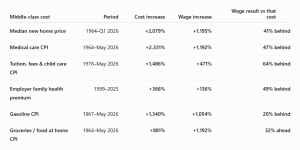
And we wonder why most middle class people are living paycheck to paycheck? Not everybody lives outside their means. A lot of people are having to go "house poor" and "education poor" just to live at a middle class level, costs that have nothing to do with any "extras".
I'm starting to really like this AI toy on my 'puter. LOL! I did some messing around and researched how much "Middle class costs" has outpaced "Middle class wages" since 1960. If you use just "inflation", it excludes categories that shouldn't be excluded. Here's what AI spit out:
And we wonder why most middle class people are living paycheck to paycheck? Not everybody lives outside their means. A lot of people are having to go "house poor" and "education poor" just to live at a middle class level, costs that have nothing to do with any "extras".
View attachment 57914
This is why I feel that the focus on taxes as to why you are behind is secondary to the fact you aren't being paid enough...


Trending content

Latest threads
-
 ESPN: Experts call for new heat rules to protect linemen
- Started by TideFans Reporter
- Replies: 0
-
ESPN: Longhorns land No. 3 RB prospect Williams-Callis
- Started by TideFans Reporter
- Replies: 0
-
ESPN: Sources: Ex-MLB official tabbed to head Big East
- Started by TideFans Reporter
- Replies: 0
-
 Interview with Civil War historian Gary Gallagher
- Started by Tidewater
- Replies: 0
-
-
ESPN: WR Hopkins tries coaching as Georgia Tech asst.
- Started by TideFans Reporter
- Replies: 0