


Issues in Education
- Thread starter Huckleberry
- Start date
You are using an out of date browser. It may not display this or other websites correctly.
You should upgrade or use an alternative browser.
You should upgrade or use an alternative browser.
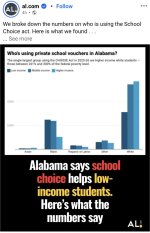


And who is surprised by this?

No one, especially the Republicans who passed the law. It's the same in other states with similar education giveaway programs.And who is surprised by this?
And who is surprised by this?
Well like charter schools… we are constantly told “it’s for the children” or “it’s for better schools”. Yet when you look at it through cold hard data you see it’s all about enriching the rich with taxpayer money or promoting white flight out of public education.
At some point the red states are going to find out dealing a death blow to public education is going to cost them far more than trying to save it. Because you are going to have massive teacher shortages and the quality of public schools will actually get worse.

I thought this was interesting.
Dr. Jared Cooney Horvath correlates the introduction of individual computers into classrooms and a drop in student performance.
Then argues for research to examine the causation (if any)
Dr. Jared Cooney Horvath correlates the introduction of individual computers into classrooms and a drop in student performance.
I thought this was interesting.
Dr. Jared Cooney Horvath correlates the introduction of individual computers into classrooms and a drop in student performance.
Then argues for research to examine the causation (if any)
There is a blind doggedness to giving every child a computer in the classroom. We went through that here in Huntsville with the Wardynski disaster. At a public forum he was presented with a concise listing of research that showed computers were detrimental compared to pencil and paper by an erudite engineer parent, and he told the parent he was an idiot, knew nothing about education, and refused to even address the issue. Every. Kid. Must. Have. A. Computer. was the mantra. One of the teachers at our elementary school was called to the carpet and threatened for using paper lessons for two days when the internet was out and they could not use the computers!
I thought this was interesting.
Dr. Jared Cooney Horvath correlates the introduction of individual computers into classrooms and a drop in student performance.
Then argues for research to examine the causation (if any)
I think lowering graduation standards has probably had a bigger impact on it than computers. Most HS are judged off graduation rates and ACT performance. When you realize that the ACT is a logic game in which it is entirely possible to get a 30 by only answering 40% of the test and then answering the other 60% C then you realize that ACT scores are not a real good measure of academic achievement. Too many schools have gone to “teach to test” to the point that they are learning nothing but test taking skills and not learning content. It’s why you are starting to see colleges push to find alternatives to the ACT.
I have not been in a secondary school classroom since 2003.There is a blind doggedness to giving every child a computer in the classroom. We went through that here in Huntsville with the Wardynski disaster. At a public forum he was presented with a concise listing of research that showed computers were detrimental compared to pencil and paper by an erudite engineer parent, and he told the parent he was an idiot, knew nothing about education, and refused to even address the issue. Every. Kid. Must. Have. A. Computer. was the mantra. One of the teachers at our elementary school was called to the carpet and threatened for using paper lessons for two days when the internet was out and they could not use the computers!
I did get to examine the products of high schools when I was teaching at Alabama and Va Tech. When I suggested students take a position and defend it using evidence and argumentation, most looked at me like a hog looking at a wristwatch. To many of them, write a ten-page paper meant sit at your computer and type whatever pops into your mind until you get to ten pages. The above average ones would spell check.
The very good ones would actually do what I told them (take a position and defend that position with evidence and argumentation). I really meant it when I said I did not really care what position they took, just how well they defended whatever position they took. Most could not do that.

So why aren’t those other demographics applying? The program is open to everyone as long as you meet the income thresholds. Last year, everyone that applied got the money.
I’m not going to argue whether the program is good or not. But you can’t blame one demographic because the other didn’t bother to apply. Yes, private schools in our area where advertising and encouraging everyone at their schools to apply.
Public schools on the other hand didn’t say a thing. We knew many families that are in public schools that had no idea about the program when we told them. All of them said they were definitely going to apply this year. Public schools are not going to advertise this for obvious reasons so the state needs to find better ways of getting the word out.
So why aren’t those other demographics applying? The program is open to everyone as long as you meet the income thresholds. Last year, everyone that applied got the money.
I’m not going to argue whether the program is good or not. But you can’t blame one demographic because the other didn’t bother to apply. Yes, private schools in our area where advertising and encouraging everyone at their schools to apply.
Public schools on the other hand didn’t say a thing. We knew many families that are in public schools that had no idea about the program when we told them. All of them said they were definitely going to apply this year. Public schools are not going to advertise this for obvious reasons so the state needs to find better ways of getting the word out.
Because the vouchers don’t pay the full cost. Most people taking the vouchers for private school benefits are already enrolled in private schools.
It’s basically reimbursing already private school and homeschooling parents.
True, I did not think of that.
Although, at least in the Montgomery area, there are a number of smaller private schools where it does cover the cost, or all but a few hundred. I think the numbers will increase this year for the other demographics, especially with Asians. Probably not a drastic increase, though.
Although, at least in the Montgomery area, there are a number of smaller private schools where it does cover the cost, or all but a few hundred. I think the numbers will increase this year for the other demographics, especially with Asians. Probably not a drastic increase, though.

This picture says it all about the state of public education in this country.
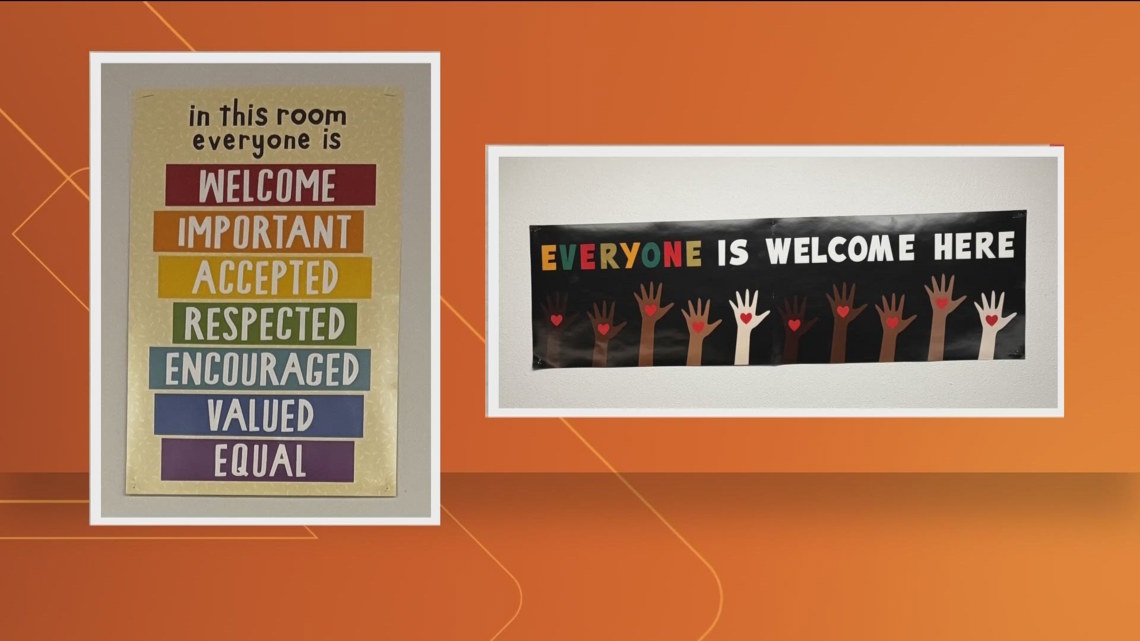
Idaho teacher sues state, school district over ban on “Everyone Is Welcome Here” posters
Sarah Inama has filed a federal lawsuit challenging a state law that led to her forced resignation after she refused to permanently remove the motivational posters.
 www.ktvb.com
Idaho teacher sues state, school district over ban on “Everyone Is Welcome Here” posters
Sarah Inama has filed a federal lawsuit challenging a state law that led to her forced resignation after she refused to permanently remove the motivational posters.... The dispute centers on two posters Inama purchased from an arts-and-crafts store in 2021 and displayed in her classroom alongside world maps, an American flag, and other educational materials. One poster read "In this room everyone is welcome, important, accepted, respected, encouraged, valued, equal" with each word in a different color. The other stated "Everyone is Welcome Here" above images of raised hands in various skin tones, each containing a red heart.


Here is a bit of good news, and from the unlikeliest of places: Mississippi:
1. They teach phonics. ("Alabama invested heavily in training on the science of reading, then known as phonics, in the early 2000s, and scores rose.")
2. They hold back 3rd graders who cannot read at grade level.
"Mississippi, for one, holds students back in third grade if they cannot pass a reading test but also gives them multiple chances to pass after intensive tutoring and summer literacy camps. Alabama will adopt a similar retention policy next school year. It also sent over 30,000 struggling readers to summer literacy camps last year. Half of those students tested at grade level by the end of the summer."
I believe in Mississippi, you can only repeat 3rd grade twice, however
Kids' reading scores have soared in Mississippi 'miracle'
Mississippi does two things:1. They teach phonics. ("Alabama invested heavily in training on the science of reading, then known as phonics, in the early 2000s, and scores rose.")
2. They hold back 3rd graders who cannot read at grade level.
"Mississippi, for one, holds students back in third grade if they cannot pass a reading test but also gives them multiple chances to pass after intensive tutoring and summer literacy camps. Alabama will adopt a similar retention policy next school year. It also sent over 30,000 struggling readers to summer literacy camps last year. Half of those students tested at grade level by the end of the summer."
I believe in Mississippi, you can only repeat 3rd grade twice, however
Here is another troubling datapoint.
"On one quiz, 29 out of 32 students responding knew that Jefferson owned slaves, but only three out of the 32 correctly identified him as president. Interestingly, more students—six of 32—actually believed Ben Franklin had been president."
"Most alarmingly, they know nothing about the fraught history of Marxist ideology and communist governments over the last century."
"He began to observe a shift in his students’ quiz responses in the early 2000s. Before that time, Pesta described his students as 'often historically ignorant, but not politicized.'"
I have no issue with mentioning slavery (for example) in a larger course about American history, as long as teachers place it in its proper context.
And I would not want the instruction of minors to be tainted with partisan politics. (College is a bit different because by college, students are mostly young adults) Using class time to prepare signs to be used in protests is, in my view, extremely unprofessional and beyond the pale. If teachers want to be treated as members of a profession (and I believe most do want that), then they must act as professionals: a professional qualification (which they have), a code of conduct as a member of that profession, and they must police their ranks.
Most college students think America invented slavery, professor finds
I am not familiar with Pesta, and I cannot vouch for his research methodology, but some of these data points are troubling:"On one quiz, 29 out of 32 students responding knew that Jefferson owned slaves, but only three out of the 32 correctly identified him as president. Interestingly, more students—six of 32—actually believed Ben Franklin had been president."
"Most alarmingly, they know nothing about the fraught history of Marxist ideology and communist governments over the last century."
"He began to observe a shift in his students’ quiz responses in the early 2000s. Before that time, Pesta described his students as 'often historically ignorant, but not politicized.'"
I have no issue with mentioning slavery (for example) in a larger course about American history, as long as teachers place it in its proper context.
And I would not want the instruction of minors to be tainted with partisan politics. (College is a bit different because by college, students are mostly young adults) Using class time to prepare signs to be used in protests is, in my view, extremely unprofessional and beyond the pale. If teachers want to be treated as members of a profession (and I believe most do want that), then they must act as professionals: a professional qualification (which they have), a code of conduct as a member of that profession, and they must police their ranks.
These examples are certainly concerning. Not because students know Jefferson owned slaves, but because many don’t know he was president. That’s a basic civic knowledge gap.Here is another troubling datapoint.
Most college students think America invented slavery, professor finds
I am not familiar with Pesta, and I cannot vouch for his research methodology, but some of these data points are troubling:
"On one quiz, 29 out of 32 students responding knew that Jefferson owned slaves, but only three out of the 32 correctly identified him as president. Interestingly, more students—six of 32—actually believed Ben Franklin had been president."
"Most alarmingly, they know nothing about the fraught history of Marxist ideology and communist governments over the last century."
"He began to observe a shift in his students’ quiz responses in the early 2000s. Before that time, Pesta described his students as 'often historically ignorant, but not politicized.'"
I have no issue with mentioning slavery (for example) in a larger course about American history, as long as teachers place it in its proper context.
And I would not want the instruction of minors to be tainted with partisan politics. (College is a bit different because by college, students are mostly young adults) Using class time to prepare signs to be used in protests is, in my view, extremely unprofessional and beyond the pale. If teachers want to be treated as members of a profession (and I believe most do want that), then they must act as professionals: a professional qualification (which they have), a code of conduct as a member of that profession, and they must police their ranks.
Teach historical injustices, but teach them alongside the fundamentals, not instead of them. Students should know Jefferson wrote the Declaration of Independence and owned slaves. One dimensional portrayals don’t help anyone understand history.
Students should also learn the history and philosophy of Marxism and communist governments. Without that, it’s impossible for them to evaluate different ideas critically.
Professionalism is also a concern. Using class time to prepare protest materials crosses a line. Schools should build thinking and social skills, not promote a teacher’s personal politics. If students want to protest on school time, then they should do so of their volition and with an understanding of the consequences.
For what it’s worth, I’m an atheist and a Democrat teaching students whose families are mostly Republican and Christian. They don’t know my personal beliefs, and that’s exactly how it should be. My job is to teach the curriculum, not my ideology. I focus on helping them with the content, critical thinking, and basic human kindness.

Good post.These examples are certainly concerning. Not because students know Jefferson owned slaves, but because many don’t know he was president. That’s a basic civic knowledge gap.
Teach historical injustices, but teach them alongside the fundamentals, not instead of them. Students should know Jefferson wrote the Declaration of Independence and owned slaves. One dimensional portrayals don’t help anyone understand history.
Students should also learn the history and philosophy of Marxism and communist governments. Without that, it’s impossible for them to evaluate different ideas critically.
Professionalism is also a concern. Using class time to prepare protest materials crosses a line. Schools should build thinking and social skills, not promote a teacher’s personal politics. If students want to protest on school time, then they should do so of their volition and with an understanding of the consequences.
For what it’s worth, I’m an atheist and a Democrat teaching students whose families are mostly Republican and Christian. They don’t know my personal beliefs, and that’s exactly how it should be. My job is to teach the curriculum, not my ideology. I focus on helping them with the content, critical thinking, and basic human kindness.
In my time in ten Hoor Hall, the left-leaning professors tended to wear their hearts upon their sleeves. Professor more inclined to the right or who were centrists/moderates, tended to clam up about that. That created a certain impression of the professoriate.
College is different from high school in that high school students tend to be minors and college students tend to be young adults. Thus, I would expect high school teachers to be even more guarded than college professors.
I was about to post the exact same thing.So why aren’t those other demographics applying? The program is open to everyone as long as you meet the income thresholds. Last year, everyone that applied got the money.
I’m not going to argue whether the program is good or not. But you can’t blame one demographic because the other didn’t bother to apply. Yes, private schools in our area where advertising and encouraging everyone at their schools to apply.
Public schools on the other hand didn’t say a thing. We knew many families that are in public schools that had no idea about the program when we told them. All of them said they were definitely going to apply this year. Public schools are not going to advertise this for obvious reasons so the state needs to find better ways of getting the word out.
The demographics of the population as a whole matter as well.
Suppose, for example, the population is 65% white, 30% black and 5% other. If the applications were perfectly distributed, you'd have two thirds of the applicants being white, not quite a third black, and the rest other.
IOW, the fact that the majority of applicants were white would be evidence that the program was race-blind, not a reason to think the program isn't helping minorities.
Excedrin example #986,987 of "journalists" rendering flawed statistical analysis in an inflammatory manner.
They don't know how to present numbers in anything other than a quick and enraging sound bite, no matter how flawed the logic is.
And even if they did present sound analysis, it rarely occurs them to ask the next question....most often, "Why is this?"
So why didn't the professional journalist ask your question -- are the non-whites applying at a lower level? If so, why?
And full banjo on your point that you can't blame one demographic because the other didn't apply.
Last edited:
Here is another troubling datapoint.
Most college students think America invented slavery, professor finds
I am not familiar with Pesta, and I cannot vouch for his research methodology, but some of these data points are troubling:
"On one quiz, 29 out of 32 students responding knew that Jefferson owned slaves, but only three out of the 32 correctly identified him as president. Interestingly, more students—six of 32—actually believed Ben Franklin had been president."
"Most alarmingly, they know nothing about the fraught history of Marxist ideology and communist governments over the last century."
"He began to observe a shift in his students’ quiz responses in the early 2000s. Before that time, Pesta described his students as 'often historically ignorant, but not politicized.'"
I have no issue with mentioning slavery (for example) in a larger course about American history, as long as teachers place it in its proper context.
And I would not want the instruction of minors to be tainted with partisan politics. (College is a bit different because by college, students are mostly young adults) Using class time to prepare signs to be used in protests is, in my view, extremely unprofessional and beyond the pale. If teachers want to be treated as members of a profession (and I believe most do want that), then they must act as professionals: a professional qualification (which they have), a code of conduct as a member of that profession, and they must police their ranks.
Well most college students also think race means color too.
Thank you, Huck. We need more teachers like you — focused on transfer of knowledge of their subject matter, as opposed to transfer of personal beliefs.These examples are certainly concerning. Not because students know Jefferson owned slaves, but because many don’t know he was president. That’s a basic civic knowledge gap.
Teach historical injustices, but teach them alongside the fundamentals, not instead of them. Students should know Jefferson wrote the Declaration of Independence and owned slaves. One dimensional portrayals don’t help anyone understand history.
Students should also learn the history and philosophy of Marxism and communist governments. Without that, it’s impossible for them to evaluate different ideas critically.
Professionalism is also a concern. Using class time to prepare protest materials crosses a line. Schools should build thinking and social skills, not promote a teacher’s personal politics. If students want to protest on school time, then they should do so of their volition and with an understanding of the consequences.
For what it’s worth, I’m an atheist and a Democrat teaching students whose families are mostly Republican and Christian. They don’t know my personal beliefs, and that’s exactly how it should be. My job is to teach the curriculum, not my ideology. I focus on helping them with the content, critical thinking, and basic human kindness.
BTW — what do you teach, and how old are your students?


Trending content


Latest threads
-
 ESPN: Big Ten, SEC add support to college sports bill
- Started by TideFans Reporter
- Replies: 0
-
ESPN: Court hands NCAA major loss on new 5-for-5 rule
- Started by TideFans Reporter
- Replies: 0
-
ESPN: Miami lands top unsigned recruit Sears for '27
- Started by TideFans Reporter
- Replies: 0
-
ESPN: FAU hires McCowan as athletic director and VP
- Started by TideFans Reporter
- Replies: 0
-
ESPN: College football X factors: Key issues for Top 25 teams
- Started by TideFans Reporter
- Replies: 0
-
 Alabama Hires Jones as Director of Ops, Promotes Keister to Expanded Role
- Started by Diamond Tide
- Replies: 0