
Polls (Some History)

THE SUMMER OF DEMOCRATIC RENAISSANCE
July 9 - August 15, 1992

Bill Clinton
arrived at the Convention in full ardor, running mate in tow, and ready to give the speech of his life. Posing as an outsider - a laughable notion given Clinton was the ultimate politician - but one who wasn't paranoid about, well, everything, Clinton stepped up in New York City and took the nomination over four days in July of 1992. Running as a responsible centrist - tax cuts for the middle class financed by the wealthy, deficit reduction, pro-choice but hardly a militant about abortion, not exactly opposed to gun owner rights, but seemingly contrarian with his advocacy of open gays in a military whose service he once eschewed and "loathed" - Clinton benefited from the pragmatism of a party desperate to regain the White House. Unlike the nomination processes that had marked the party as the rule since 1972, Clinton did things (and took positions) that never would have been allowed by the conventions that nominated George McGovern, Walter Mondale, and Michael Dukakis. He was on the record as favoring the death penalty, he talked about how "welfare recipients" must "show responsibility" (a comment that would still be held up today as racist if Clinton was a Republican), and his record on the environment in Arkansas was mediocre at best. But good fortune plays as much a role in a Presidential election as anything, and Clinton benefited from the fact the first-ever African-American party leader, Ron Brown, gave Clinton cover every time the Hard Left reared its head.

And speaking of luck, Clinton was born under a four-leaf clover given what occurred on the memorable afternoon of July 16, 1992, when the biggest bombshell in the race went off: Ross Perot, who had been in a dead heat with the incumbent President and the beleaguered centrist challenger, committed political seppuku and withdrew from a race he had technically never even entered in the first place. He went through the process of firing both of his campaign managers, blamed them by saying "there had never been a bad story about me until you guys came aboard," and inserted himself into the Democratic National Convention mere hours before Clinton was to give his acceptance speech, an act that necessitated Clinton rewriting sections of the monologue. Perot declared that since the Democratic Party has "revitalized itself" he had "concluded we cannot win in November" because "the election would be cast into the House of Representatives." Donning a cloak of virtue, Perot said that that delay would impinge the incoming administration and narrow the transition window, so he was withdrawing.

His claim was so laughably absurd on its face that nobody took it seriously. Newsweek ran a headline calling Perot "Quitter", and Ed Rollins, Perot's just fired Republican manager, said that Perot was withdrawing because he didn't want to listen to the advice of professional consultants (like Rollins) and do things like polling, holding a convention, or run targeted TV ads.

His excuse was not only pathetic, it would take less than two weeks for Perot to come out and say he withdrew because the Bush campaign was going to sabotage his daughter's wedding. Forgotten was any of his nobility about the country.

The news hit the country like a nuclear bomb. And it is also one of the reasons that Republicans insist to this day that Perot cost Bush the election. Did he? Most probably not, but I will cover that in the epilogue. What is indisputable, however, is that liberal columnist Mary McGrory AT THE TIME wrote:

In the lobby of Clinton's headquarters hotel, the Inter-Continental, Clinton pollster Stan Greenberg was unleashed to explain the aftershock. The South, which supposedly had been sewed up by the southern-fried Clinton-Gore ticket, will now be contested. Had Perot stayed in, he would have robbed Bush of the usual GOP majorities.

In short, Perot's participation was at least going to distract Bush from being able to take the South for granted. And there was another - for the time - short-term benefit: Perot's withdrawal was a booster rocket attached to the Clinton campaign, showing the Arkansas Governor with a 42-30 lead over Bush (it was tied at 30 for all three entering July). And then came the long-term benefit: a bus trip through the Rust Belt designed to ride the momentum to election. It succeeded far beyond the Clinton campaign's wildest dreams, even praised by Republican consultant Charlie Black as a "master stroke." By the time it was over, Bill Clinton was an incredible 24 points ahead of Bush, the largest lead of any Democratic candidate in a Presidential elections since Carter's 33-point lead over President Ford in 1976.

With Perot gone and Clinton roaring into the lead, the scrutiny now focused on President Bush and one particular question: should he dump Dan Quayle as his running mate for the fall election?
 
  • Like
Reactions: Huckleberry
THE REPUBLICAN PHANTOM NOMINATION - AND PRE-CAMPAIGN

The Republican campaign was over the moment Pat Buchanan lost to George Bush in New Hampshire.
This should have been a blessing for the campaign and time to prepare for the fall campaign, particularly since Bill Clinton was the obvious nominee at the end of Super Tuesday. But Bush was about to learn how a President largely on the sidelines away from the race and with the other party in control of both Houses couldn't really do very much. And he was also learning how brutal outside events could impose themselves on a President and cripple his ability to function.

For three solid years, Bush had been incredibly lucky as to outside events. Forgotten today is how much change really occurred in the larger world between 1989 and 1991, with the Soviet Union and Yugoslavia going out of existence, several Eastern European countries having internal revolutions and throwing off decades of Communism, Germany reuniting, a war that put Iraqi dictator Saddam Hussein in his place, a coup in the Soviet Union that was beaten down in a few days, a massacre in Tianneman Square, and rapidly moving towards approval of the North American Free Trade Agreement (NAFTA) that was hoped would help North America counter the rapid development of a united Europe. Every time something had gone wrong, Bush had come out smelling like a rose; every time it went right, he got credit merely by being. Bush even got two nominees to the Supreme Court approved by a Democratic majority. But all of the good luck turned to bad when the calendar turned to 1992.

Buchanan savaged Bush as "not a real conservative." The biggest issue was his broken promise on taxes, an act that cost him his political base and reputation (high as far as politicians go) for integrity. But Bush would have gotten away with this had the economy not cratered in the worst recession since the Great Depression. No, it wasn't Bush's fault, but he was the one entering the 12th year of Republicans being in charge.

It got worse.

Perot entered the race and clearly had a personal disdain for Bush, whom he had invited to go to work for him after Bush left the CIA. The suspicions as to why Perot loathed Bush turned on two issues, his feeling that Bush (unlike Perot) had never made "real money" but more so that Bush, in 1986, had stopped Perot's attempts to locate POWs and MIAs in Vietnam all on his own. And it got worse.

When a Simi Valley jury acquitted four LAPD officers of all but one charge in the beating of motorist Rodney King, the city of Los Angeles went up in flames. Making it worse, Clinton made it to LA before Bush did and won the publicity race, too. And it continued to get worse. His Vice-President, Dan Quayle, went out and got on a roll firing up the conservative base, and Quayle was popular among that base as a "real conservative." But then Quayle flubbed it twice, getting into a fluff with popular TV actress Candace Bergen over and episode of her show, "Murphy Brown," and then relaying a word that was misspelled on the back of a card during a spelling bee ("potato" spelled "potatoe") to the ridicule of the public as a whole, who didn't know the details. With those two gaffes, Quayle reinforced that he was an out of touch rich white guy with a trust fund who wasn't exactly Einstein in the brains department. And after Clinton roared out of New York to a huge campaign lead, the question was put to Bush: "Should we throw the excess baggage (Quayle) overboard and start afresh?" Names like Colin Powell and Dick Cheney were brought forth, ties to Bush's successful sojourn into war.

But it was one consultant who went nose-to-nose with Bush and told him the facts of life: nobody votes for VP anyway, if Quayle is wrong now, he was wrong in 1988, and do you really want to tell the entire country "I had no idea what I was doing"? That didn't stop both Bush and Quayle from committing further blunders and getting drawn into conversations about what they'd do if their own daughters had abortions. The issue had renewed salience when the High Court stopped just short of overturning Roe v Wade at the end of June. And as if all this wasn't bad enough, Bush's convention didn't help.

Held in Houston, Texas, the Convention was by no means as bad as the coverage was, but it still gave the nation a picture of a party of nearly all-white and well-off speakers consumed with social issues like gay marriage and abortion - and a President whose numbers had tanked in one calendar year due to his perceived inattention to the economy. The media spin on the Convention was that it was a terrible ode to bigotry - but the fact is that for a "bad" Convention, the Bush campaign cut the Clinton lead from 24 points to a more manageable 8 within a week. So for all of the bad coverage and memories of the 1992 GOP Convention as a religious revival, the reality is that by the measurements of "bounce," it was successful, too.

Beneath the numbers, however, was a serious problem for the GOP: at the end of July, STATE polls showed an incredible reality, with Clinton holding either a lead or a narrow deficit in every single state except Utah. It was similar to the 1968 election when Nixon held leads in 46 states at the Convention and wound up winning at the very end by the narrowest of margins. Had Nixon lost California (he won their 40 electoral votes by less than 3 points), he would never have been President. So although Clinton had nothing but good news at this point, the fall campaign was about to begin with memories of Bush rallying the forces just four years earlier to wipe the floor with Michael Dukakis.
 
  • Like
Reactions: Huckleberry
TWO FLAWED CANDIDATES AWAITING A THIRD
September 1992


All year long, the assumption was that this race was George Bush's race to lose. Clinton was a second-tier candidate who only entered the race because the big names in his party - Cuomo, Bradley, Nunn, Bentsen, Gore, Rockefeller - had all sat on the sidelines dazzled at Bush's 91% approval rating in April of 1991. Clinton was also the master of the dangling participle or incomplete statement that sounded like it had been vetted through lawyers as the small print in a legal contract that he planned to pull as a technicality to defend himself from any charge he was actually "lying." In the back of the Democratic minds was a Democratic myth from 1988 that would not die, one that was never true in the first place, and even if it was, it had no relevance this time anyway. It was the idea that Bush was the master of coming back from deep poll deficits to win elections, and he would use any means fair or foul to win. The most constant appeal was for Clinton's side to reference "Willie Horton," the convicted murderer and rapist on furlough that Democrats imagined was the reason they lost the 1988 election. And Bush had made a stellar effort when up against it in New Hampshire in 1988 and the fall election of 1988. He reached into his bag of tricks and dusted off the same playbook used in 1988: Clinton was "the governor of a small, failed state" was the charge. It had worked in 1988 and the assumption across the spectrum was that it would work again in 1992. It was the fear of the Democrats and hope of the Republicans, particularly since the economy may have been growing but didn't feel like it to enough people to save Bush.

But there was one key difference in the race this time: Bush was no longer the Vice-President of the United States with a mostly clean slate who could take a carefully crafted position that was a break with his boss. Bush in 1992 was a President of three years in the White House who now had a public record hung around his neck as an albatross. If Bush's argument was that Clinton was the failed governor of a small state, Clinton's counterpunch was far more brutal: "Bush is the failed President of a great nation." And almost every time Bush talked about honesty and brought up Clinton's dissembling on issues, all Clinton had to do to take the edge off the attack was a variation of, "I'm not the one who said read my lips and then raised everyone's taxes." And unlike the last four Democratic losing candidates, Clinton was willing to lie to the public and dangle a middle-class tax cut that the rich were going to pay for in order to entice the broadest span of the electorate.

To put it another way, Clinton was running a smart centrist campaign.

THE CLINTON STRATEGY

Paul Tully
, who died at age 48 in September 1992, formulated the election strategy, an obvious strategy that the Democrats had failed to use previously. Take the Dukakis states for granted (start with 112 EVs), work most heavily in the battleground states Dukakis lost by less than 5 points (PA by 2, CA by 4, IL by 2, MO by 4, MD by 3, for a total of 97 EVs, bringing Clinton to 209), do some campaigning in the South to show you were not a Northeast liberal (add in AR and TN for 17 more, bringing Clinton to 226), and hammer home the economic message in the Rust Belt states of Ohio, Michigan, and New Jersey (54 more EVs, or 10 more than necessary to win). Plus, if Clinton could just pick up a stray Southern state like Georgia or Kentucky - conservative states still inclined to vote Democratic - he had an insurance policy. Unlike every election since 1972, the Democrats were taking the field with the wind at their backs, a country reeling from recession, and one with a strong appetite for change. For the first time since that election, the Democrats were not in the position of having to "fill the inside straight" (e.g. win every close state to win the whole thing).

And a review of the state polls from September proves that Clinton was playing with house money regardless of whether the RNC was good or bad for the GOP.


IMG_4272.jpeg


IMG_4273.jpeg
September was dominated by three stories:

1) Clinton has a lead, but he doesn't have the election nailed down just yet. A look at the above map shows the problems Bush had: look at how many Southern states as part of his base were "lean" and not nailed down? Bush was in trouble. South Dakota.......SOUTH DAKOTA.......was a toss-up.

2) Bush is not only floundering, he's refusing to debate Clinton - and every day that goes by, he's throwing away his chances to turn the race around.

3) Why is Ross Perot, who isn't even running, spending money and filing with the FEC?


This last began as a trickle and then - when Perot dropped his own third big bombshell of the year on the country by re-entering the race on October 1 - it wasn't even a surprise by that point.
 
1992 - THE REALIGNMENT ELECTION

Over the course of six Presidential elections, the Republican Party held what felt like the equivalent of an electoral college lock, winning five of the six elections (and coming within less than 10,000 votes of winning the other via the Electoral College in 1976), four of those in blistering landslides, two of them by counts of 49-1. Keep in mind this was a political party that had been nuked out of existence in 1964 when Lyndon Johnson routed Barry Goldwater, and the GOP began a conspicuous rightward turn within their nominating wing. And also keep in mind the Democratic Party had won seven of the nine elections prior to this Republican period of dominance at the Presidential level and the two they lost - Eisenhower's wins in 1952 and 1956 - weren't even that big of a thing because Eisenhower wasn't regarded on the whole as a partisan Republican so much as he was a beloved general. Indeed, President Truman tried to get Eisenhower to run in 1952 as a Democrat, and he felt Ike was holding back his party affiliation in hopes both parties nominated him and there wouldn't be an election. But starting in 1968, the Republican Party first escaped with a narrow win in 1968 and then repeatedly beat Democrats like a drum as the nomination process changed along with the country.

Democrats, of course, needed an excuse as to why they began losing elections and they found an easy culprit: the Republican Party is appealing to racist voters with dog whistles known as the Southern strategy. This strategy (in the tale) led to white voters in the South leaving the Democratic Party en masse and giving the Republicans the White House for 20 of the next 24 years. While of questionable accuracy as an excuse, there's a larger problem for the Democratic Party that consultants (as opposed to propagandists) had to accept: Richard Nixon would have won the White House anyway in 1968 regardless of any alleged Southern strategy simply by carrying states he had carried previously in the South as either Ike's running mate or in his own losing campaign in 1960 (to say nothing of the fact he finished THIRD in the "most racist" states in the south, too). And here's the rub: the same is true for every single Republican win from 1968 through 1988. The Southern states outside of Tennessee, Kentucky, and Virginia - states that were already voting for Nixon - did not have anything at all to do with Republicans winning elections at the Presidential level. But that's getting ahead of the discussion of 1968, except to make this point: the Republican Party wasn't so much winning elections because of the South - although, YES, that made their jobs easier - they were winning because they were capturing the Rust Belt states between New Jersey and Wisconsin while also winning the big electoral prizes of California and New York. In essence, the areas that had previously provided the Democrats with their winning margins at the Presidential level now had enough swing voters pulling the lever for a Republican. When Texas made their own flip, the Democrats had a serious problem on their hands at winning nationally. And the key to any Democratic comeback was going to have to be to win the big states with the big prizes - starting with California, and it is here that a more sober analysis prevails. The South DID begin to fracture as the Democratic Solid South beginning with Strom Thurmond's third-party run in 1948, but the reality is that the South wasn't the only geographic area to "switch sides" over the next 40 years, either. (32 states of the 50 voted for the opposite party in 2024 that they did in 1976).

When the GOP won five of six elections in 1968-88, the biggest reason was that Democrats could not seriously contest California. In four of those elections, a former California Senator (Nixon) or Governor (Reagan) headed the GOP ticket, and the GOP went 4-0. In the last GOP win in 1988, a relatively unpopular in California George Bush prevailed by 3.5 points thanks largely to Reagan campaigning on his behalf. And in four of those elections, the GOP also won New York, a huge electoral prize. With their Western base (almost every state west of the Mississippi River except - would you believe it - Texas), the GOP was the team playing with house money. It was so one-sided that in the late spring of 1984, Lee Atwater sat down with the party elders and a map and spelled out that Reagan had already locked down 266 electoral votes by virtue of the nomination of Walter Mondale. All they had to do now was not screw up, and they were going to win anyway. (Nixon would later advise the GOP to treat Ohio as a governor's race and bombard the state with appearances and ads to lock the race down, a strategy followed to the letter.

But in 1992, the GOP ran straight into a buzzsaw of a changing electorate, an economy that felt worse than the numbers, and a communication challenged Yankee who couldn't communicate his vision to the country. They also ran into a Democratic Party that - finally - after 20 years of infighting had decided it was better to win the White House FIRST and then start tearing one another apart. They also ran into a Democrat actually willing to lie about his intention on raising taxes, one willing to say that he'd LOWER them on the middle class and make the rich pay for it. McGovern, Mondale, and Dukakis were never so brazen, but they were also never so charismatic, either.

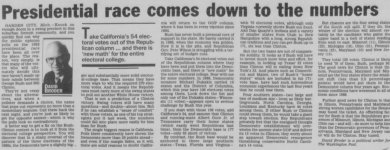
The shifting of California from a GOP stronghold to one of the most liberal states in America where a Democrat nowadays doesn't even have to campaign occurred across the period of around 1986 to 1992. The GOP has not even come close to winning the state again and will not for the foreseeable future. This changing electorate was first noted around Labor Day by liberal commentator David Broder.

IMG_4274.jpeg
 
  • Like
Reactions: Huckleberry
THE DEBATES AND THE RACE THAT WASN'T
October 1992

Ross Perot
joining the race on October 1 grabbed attention, the only asset he had apparently brought to the race in the first place. Over the final two weeks of September, he had been backdoor negotiating with both parties and making his list of demands for his endorsement. In fact at one point, Perot was seen by one of the powers that be in one of the parties walking out of a room with them - and right into another room with the opposing side after pretending he was all on board with the first group.

And now the question came: which candidate is hurt more by Perot entering the race? And the answer, viewed in terms of both the polls at the time and common sense, is Perot's entry into the race hurt
Bill Clinton more than it did President Bush. (I'll have more commentary on that subject two posts down). The short version, though, is that Perot unnecessarily divided the coalition of voters AGAINST the incumbent. The 1992 election - as all elections featuring an incumbent - was a referendum on the incumbent, in this case Bush. With polls showing the "wrong track" number nearing 70% (just as in 2024), the entire election came down to the pro-Bush voters vs the anti-Bush voters. And the anti-Bush voters were now split between two flawed candidates who were hardly equally flawed.

This and despite the nonsense you hear every election, 90% of the electorate has made their minds up before Labor Day.

These facts meant that Perot's entry into the race by definition hurt Clinton more than they hurt Bush. Whether his entry "really" hurt anyone, of course, is conjecture up to a point because how many of those folks who voted for Perot would have otherwise either stayed at home or voted for a lesser candidate down the ballot? It's difficult to tell since the USA does not use ranked choice voting. But before we can commentate on that subject, there's another reality: the debates, postponed because Bush refused to take on the Rhodes scholar earlier, now had no choice but to include Perot, whose support was above the 15% threshold necessary for an invite. Between October 11 and 19 - NINE DAYS - three Presidential and one Vice-Presidential - debate occurred, and the only thing they accomplished was interrupting the TV schedule and keeping the candidates off the stump for 10 or 11 days which could only benefit the candidate leading, in this case Clinton.

There was sharp disagreement over who won the debates, but the clear loser was President Bush. He had the misfortune to being the piece of meat two dogs took turns at taking a bite, and the most memorable moment came when Bush looked at his watch, looking for all the world like a man who wished he was somewhere else, anywhere else but on the debate stage. Perot's running mate, Navy Admiral James Stockdale, was shown to be out of his league in the VP debate, a fact that made Perot seem even more atrocious as a potential President.

Bush wasted most of the last month debating Clinton, Perot wasted most of the last month trying to capture just enough votes to throw the race into the House of Representatives, and Clinton spent the last month trying to not look overconfident.

The final pre-election national polls were as follows:

USA TODAY/CNN
Clinton 43
Bush 36
Perot 15

ABC NEWS
Clinton 42
Bush 37
Perot 17

LOU HARRIS
Clinton 42
Bush 38
Perot 16

WASHINGTON POST
Clinton 43
Bush 35
Perot 16


ACTUAL ELECTION DAY RESULTS
Clinton 43
Bush 37
Perot 19

IMG_4278.jpeg

IMG_4279.jpeg
 
  • Like
Reactions: Huckleberry
DID PEROT (HELP) COST BUSH THE 1992 ELECTION?

On November 3, 1992, Bill Clinton beat George H.W. Bush by an electoral vote count of 370-168, winning 32 states plus Washington DC. Bush, who had carried 40 states in 1988, lost 22 of those 40 states to carry 18 (mostly in the South and Western Plains, and suffered the biggest negative referendum on an incumbent since the Republican Party of 1912 split between President Taft and former President Teddy Roosevelt.
Even Herbert Hoover's loss in the wake of the Great Depression was not as much a reversal as Bush suffered in 1992, as his popular vote dropped from 53.37% to 37.45% (Hoover and Goldwater both carried a higher percentage than did Bush in 1992, even though both were blown out). Perot got nearly one out of every five votes nationally and actually finished ahead of the President in Maine, where Bush's family has held a summer home in Kennebunkport for years. The 22 states Clinton flipped are as follows: Arkansas, California, Colorado, Connecticut (where Bush's father had been a Senator), Delaware, Georgia, Illinois, Kentucky, Louisiana, Maine, Maryland, Michigan, Missouri, Montana, Nevada, New Hampshire, New Jersey, New Mexico, Ohio, Pennsylvania, Tennessee, and Vermont. And almost immediately, it became an article of faith among Republicans that Bush "only lost because Perot swung the election to Clinton." Some of their "evidence" at least sounded reasonable but much of it took the form of a conspiracy theory, unproveable at all stages.

There was one solid suggestion in favor of the hypothesis: the Democrats won an Electoral College landslide, but they didn't gain any seats in the Senate, and they actually had lost 9 House seats. But the Democrats had picked up one Senate seat each in 1990 and 1991, and they'd gained 8 House seats in 1990, so losing those meant next-to-nothing. Given the Democrats had 30 governors, one could hardly argue the GOP was popular around the USA.

The conspiracy theory version goes sort of like this:

Perot attacked Bush incessantly before "withdrawing" (true) on the day Clinton gave his acceptance speech (true) which pushed Clinton ahead by 24 points (true), which made it impossible for Bush to catch him. Then, just as Bush was catching him and had narrowed the gap (true - sort of), Perot re-entered the race (true). The basic premises of the pro-Bush side are all true, but they don't necessitate the conclusion that this means Perot cost Bush so much as a single vote much less the entire election.

The first problem is the most obvious: on what basis can anyone claim that if Perot was not in the race that 3/4 of his voters in the right states would have voted for Bush? Granted, Bush came closer than is often realized. In fact, if just a little over 300,00 voters spread out across ten states had voted for Bush rather than Clinton, Bush would have narrowly won the Electoral College despite 5 million fewer votes. But it is not enough to talk about Perot voters - you have to get them TO VOTE FOR BUSH, too.

I have looked at the state-by-state data. Consider the brutal reality: Clinton got more votes than Bush and Perot combined in New York state. Looking at the state by state data, I feel comfortable saying that Perot almost certainly cost Bush the state of Montana (he lost by 10K and Perot got 107K) and probably Ohio (Clinton won by 90K and Perot carried over a million votes). He might - and this is more debatable - have cost Bush the state of Georgia, where Perot got 309K and Bush lost by 12K votes. I'm less certain regarding Georgia simply because Clinton was a known Southern Governor when Georgia was more Democratic than today, and the state had two Democratic Senators then (Nunn and Fowler, although Fowler lost a runoff to Paul Coverdell in December 1992) and Zell Miller as governor. I'm willing to say that Perot cost Bush two states, maybe three, which would have simply reduced the margin of the defeat.

At the same time, however, Perot probably cost Clinton the state of Arizona (29K deficit, Perot got 353K votes).

But here's the other issue: how do you blame Perot for Bush losing when Bush was leading with Perot in the race earlier? And when Perot re-entered the race, it took more from Clinton than it did from Bush nationally, even though many conservatives don't want to admit it. It is indisputable that Perot seemed to have a special animus towards Bush. He would attack the President incessantly and would barely utter a word about Clinton unless pushed hard enough - at least until the final week when Perot suddenly turned his guns on Clinton, too. The assumption is "well, Perot ran as a conservative," but did he really? Yes, he ran as a deficit hawk who was going to raise taxes and cut spending, but he was a social liberal (for the most part), and he kept working everything back to the need to raise taxes on everyone. That might be 1950s conservatism but it wouldn't have gotten him halfway down the line to first base in the Reagan party.

I'm sure it makes conservatives "feel better" to say that "we only lost because of Perot," but the problem is that it's like any other religious belief. You have to ASSUME Perot's voters would have voted for Bush by a huge number in the right states. And while that's POSSIBLE, we don't base political conclusions on possibility.

Perot was not the failure of the Bush campaign. It was the Bush campaign's failure to cash in on the Perot vote early in the race when they were still there for the taking.

1992 is over.

And I'll close it out with polls from the bizarre and sad year of 1968.

Suffice it to say, almost everything you've heard about that election is wrong or at least a tad twisted.
 
  • Like
Reactions: Huckleberry
1968: THE REPUBLICAN CONTENDERS

On November 3, 1964, the Democratic Party reached one of its last high-water marks in history. Lyndon Johnson routed Barry Goldwater in a smashing landslide that surely would mark the completion of FDR's New Deal with the addendum known as the Great Society. Johnson won by a popular vote margin of 61-38, and an electoral vote drilling of 486-52. Goldwater carried only six states, five Deep South states rebelling over the passage of the Civil Rights Act of 1964 and his home state of Arizona. The Democrats also picked up 36 House seats to give them a 295-140 margin, the largest since 1936, and they added a net two Senate seats to increase their margin to 68-32. The only blemish for the Democrats was they lost the governorship of Massachusetts when Endicott Peabody narrowly lost the Democratic primary and Republican John Volpe triumphed Democrat Francis Bellotti by less than a point in the general election. The huge numbers meant that Johnson should be able to sign into law things like the Voting Rights Act (1965), Medicare, Medicaid, and a highway beautification bill, which he did. He also managed to undo virtually all of his good name by dragging America into the first war it would ever lose, Vietnam. By 1968, Johnson's popularity would be sagging enough to destroy his Presidency, Walter Cronkite would categorize the war as a stalemate, Hubert Humphrey would find that combining a coalition of "peace with honor" advocates and anti-draft advocates would be impossible, and Richard Nixon would wake up as President four years and three days later by winning a 43% plurality vote split among three candidates, the last a lightning rod for controversy on the always touchy subject of race. As is almost always the case, Nixon's triumph was viewed - after it occurred - as inevitable, but the idea of a Republican winning in 1968 seemed virtually impossible as 1964 ended. Remember, with Johnson's triumph, the Democrats had won seven of nine Presidential elections and they'd lost two to a popular general who, while a member of the Republican Party, was largely seen as a nonpartisan. The GOP as a brand had not won a Presidential election in nearly 40 years, and they were still blamed for the advent of the Great Depression.

Goldwater's loss had, supposedly, destroyed conservatism. But the GOP would begin to right the ship almost immediately, and it was Johnson himself who noted that his 16 million vote margin was artificial and going to dissipate quickly. In essence, he argued that 3 million of those were Republicans that Goldwater had terrified, and he'd lose another 3 million when he began to act and affect voters. Johnson suggested in early 1965 that his margin might be cut almost in half by the late summer of 1965. And as he escalated American involvement in an Asian land war, those numbers receded accordingly though slowly at first. After all, who exactly did the Republicans have who was going to be able to win the thing?

Three big names remained from 1964: Nixon, Nelson Rockefeller, and William Scranton. But all had liabilities that apparently exceeded their assets. Nixon was seen as little more than a losing candidate who couldn't win, having added the loss in the 1962 California Governor's race to his narrow loss in the 1960 election. Rockefeller had angered the party with his political liberalism, his wealth, his shameless divorce that wrecked two families, and his division instead of getting behind Goldwater when the latter won the nomination in 1964. In fact, just two days after Goldwater's defeat, Nixon began laying the groundwork for 1968 by blaming Rockefeller for dividing the party: "A man who runs for the nomination, pledges his support for the winner and then takes a walk cannot come back and say he wants to be the leader" ("A Spoilsport, Too," NYT, 11/6/64). Nixon's larger point was that Rockefeller's divisiveness hadn't in any way caused Goldwater to lose, but it had affected races down ballot. Nixon also urged a move away from Goldwater extremism to centrist campaigning. Rockefeller responded to Nixon by announcing that this was the type of "peevish, post-election utterance" for which Nixon was known. In modern parlance, Nixon had trolled Rockefeller, and he took the bait, which moved Nixon into higher regard among conservatives.

Scranton, despite being an excellent governor of a large state (Pennsylvania) simply wasn't ambitious enough to set his course for the White House. He was the kind of guy who might make a great running mate, and he was effective as governor, but he simply wasn't yearning for the job. And Nixon moved dead center a week later in the same NYT by saying the right and the left of the Republican Party deserved representation, perhaps Nixon himself as he was "dead center." And despite later historical revisionism, this was probably correct. Chosen as Ike's running mate because of his perceived staunch anti-Communism, Nixon was also the son of a Quaker and came from a pro-union family. It is true that Nixon's positioning was politically motivated, but it's equally true that it was the closest representation of precisely who he was, listing as his heroes Teddy Roosevelt and Woodrow Wilson and calling himself "a progressive conservative" (Cohen: 2016, 207).

There were other names that rose and fall prior to 1968, some bobbing back up later and some disappearing forever. The general rule of thumb was that a nominee had to come from a big state and since the Democrats held such a dominant position across the country, it reduced the number of potential candidates severely. The only Republican candidates who held either a governorship or a Senate seat at the start of 1965 were governors Rockefeller (NY), George Romney (Michigan), Jim Rhodes (Ohio) and Volpe (who was just taking office in MA) and Senators Thomas Kuchel (California), Everett Dirksen (Illinois), Jacob Javits (NY), and George Murphy (CA). Only Romney and Rockefeller among these were serious candidates as the others all had serious drawbacks from age (Dirksen was 68) or religion (Javits was Jewish) or just plain idiocy (Rhodes, who would later oversee a massacre at Kent State). With a vacuum this large of only three candidates, it was inevitable more would arise.

In 1965, the sparkling new name was John V. Lindsay, the newly elected mayor of New York City. A Protestant Republican mayor of New York is almost unheard of, but Lindsay rose to power since Rocky wasn't giving up the governorship, and Javits and Bobby Kennedy had the Senate seats locked down for life if they wanted them. Well, maybe not Javits, who lost his as he aged. (Historical note: Javits won his seat in 1956. That seat has been held by only 3 people since January 1957: Javits, Alphonse D'Amato, and Chuck Schumer). But Lindsay was a bright light in the media pecking order along with Romney, who many viewed as the stalking horse for Rockefeller. Then in 1966, a new name was added to the roster, and it was a name that would compete in 1968 and later become the best-known Republican name of the last half of the 20th century: Ronald Reagan. Just 11 days after being elected governor of California - in a stunning upset of Pat Brown in 1966 - Reagan's group met to discuss whether or not the 1968 Republican nomination might be worth having. By this time, LBJ's numbers were beginning to decline as concern over Vietnam grew, and as governor of the largest state, Reagan automatically was thrust towards the front of the line as a potential President. There was just one real problem where it concerned Reagan: this was a guy who had launched his career by giving a speech a week before Goldwater's brutal defeat called A Time for Choosing. Perhaps no other candidate in American life was so attached with the pariah Goldwater. Reagan was further undone by a staff scandal in 1967, where a closeted gay member of his staff was packing the governor's office with aides and advisors whose primary qualification was their sexual orientation. While Reagan was by no means anti-gay, this was 1967, and the fallout from the scandal pushed Reagan inward to his closest advisors. For the rest of his political career, rarely would an outsider ever be able to penetrate the Reagan inner circle, all due to the fallout from this scandal.

If the Republicans were in trouble heading in 1968, the Democrats were in even more trouble. The problem for them was they didn't just yet know how much trouble they were going to find before the primary season kicked off. And we look next at Johnson's tenure and how it shaped up entering 1968.
 
  • Like
Reactions: Huckleberry
THE DEMOCRATS: PRELUDE TO DISASTER

LBJ
flourished in the White House in 1965, passing the most significant legislation by the biggest majorities since FDR's first term. But beginning in 1965, he would also plunge the country, his presidency, and his party deep down into an abyss from which they would not fully recover until the early 21st century. From January 4 to October 23, 1965, no less than 87 bills would make their way through Congress, of which 84 would become law, an impressive feat. But the conflict between federal and state governments - and who oversees what - would be left for courts to decide because a number of the items passed were fuzzy on details to put it mildly. Johnson was for better schools, better highways, better healthcare, and only those opposed by principle to big government could find anything wrong with it. At first.

On June 4 at Howard University, Johnson staked the success or failure of his Great Society on improving the lives of black Americans. The cherry on top was the Voting Rights Act of 1965, signed on August 5. All was well for six days. Then, on August 11, what would become all too commonplace in the 1960s - riots, this one starting in Watts (near Los Angeles). The riots introduced a racial counterweight to the nonviolent protests of Martin Luther King Jr: the Black Power movement and the Black Panthers, with militants such as Stokely Carmichael, H. Rapp Brown, and Eldridge Cleaver. The Watts riots left 34 Americans dead, over 4,000 injured, millions of dollars in damages, and saw the deployment of the National Guard to restore order. In 1970, Life magazine would declare that the Watts riots, not the JFK assassination, was the true dividing line of the 1960s. As if this weren't bad enough, Johnson announced he was sending 135,000 more troops to Vietnam, putting him on the precipice of calamity both domestically and in foreign policy. But while it is undoubtedly true race played a role in the growing conflict at home, all of the polling at the time showed whites nationally largely sympathetic and in agreement that black grievances were both real and had to be addressed. Consider another group that got less support and sympathy than black Americans, the hippies. The hippies smoked pot, protested the Vietnam War, flouted convention at traditional notions of sex and marriage, religion, and language. Indeed, towns not overly consumed with racial problems found their lives disrupted by challenges from the hippies. In short, everyone was angry. "The right" was angry over what they called "liberal social engineering," the left was angry over the Vietnam War, and American trust in government fell from 61% to 45% in just two years. It has - with the exception of a brief bump immediately following the September 11, 2001 attacks - gone down every year since 1966.

This was the world that saw Lyndon Johnson as the leader of the free world, and the assumption for most of the time frame between 1964 and his shocking withdrawal on March 31, 1968 was that Johnson would probably seek reelection. Except Johnson's case was not as obvious as it has been in many others because Johnson had suffered a heart attack when he was 46 years old in 1955. That fact alone made being his Vice-President a literal heartbeat away from the Presidency, but the whittling away of politicians supporting Johnson barely scratched the surface even as cities continued to go up in flames and soldiers continued to get drafted, sent to Vietnam, and die on a daily basis. But it should also be noted that knocking off a king (President) in 1968 was not even as easy as it is today, when it still isn't easy, because the primary system was not the predominant selection process for delegates for the nomination. Although a few states like New Hampshire, California, and Oregon still held contests, most delegates were awarded by the party at state conventions or other gatherings - and most were under the strictest thumb of whomever was the President in the case of incumbency. And the first cracks in the foundation happened at the 1966 midterms. With Richard Nixon leading the campaign flag, the Republican Party inflicted serious damage on the Democrats' big advantages in government.

Prior to the midterms, Nixon went on the record with a wild prediction: the GOP was going to pick up 40 seats in the House, three Senate seats, six governorships, and 700 seats in the state legislature. His prediction was not as bold as it sounds, of course. The GOP had lost 36 House seats in the 1964 disaster (and freshmen are the most vulnerable), the Democrats were defending 20 of the 35 Senate seats up for election, and this would be a typical mid-term pickup even though the numbers sounded impressive. On Election Night, Nixon hit 3 out of 4 quite well as the GOP picked up 47 House seats, three Senate seats, EIGHT governorships (including Reagan's stunning win over Pat Brown in California), and 540 legislative seats, Nixon's only miss. But given they had lost 171 legislative seats in 1964, it was more than break even and all of a sudden the GOP could think about possibly winning the Presidency in 1968. And the man who was owed the most, of course, was Nixon.

It was right about this time that Johnson's poll numbers began to decline and never again recover. Johnson's Gallup poll approval rating peaked in February 1964 around 80% as he led the country through the trauma of the Kennedy assassination. After Johnson attacked Nixon's patriotism and the GOP picked up legislative seats, Johnson's disapproval rating topped his approval rating for the first time on November 24, 1966 - two years to the day after the killing of Lee Harvey Oswald.

In early 1967, an informal poll of Democratic state chairs (44 responded) and lesser knowns in the party supported LBJ for re-election, primarily because he was the incumbent President. But underneath was party support to replace LBJ with the brother of the man whose death opened power to Johnson, Robert F. Kennedy, Senator from New York. And underneath the surface, a storm was brewing in the party.

Eugene McCarthy was the "other" Senator from Minnesota, after the Vice-President Hubert Humphrey. McCarthy was a poet and an intellectual as well as a former college baseball player, and he was other things, including aloof, arrogant, and cold. The Wall Street Journal polled Democratic senators and one anonymous comment said it all about McCarthy: "Out of 100 liberals, he would be 99th on my list, he is not worth a damn." McCarthy was one of those politicians who prospered in the system as it was and then blasted the system as being bad. He dismissed all of the other Senators as "the savages of New Guinea" as well as "the last primitive society in the Western world." McCarthy felt he should have been selected as Johnson's VP over Humphrey, a point so well-known that many of his fellow liberal Democrats assumed his seeking the Presidency in 1968 was anger over what he perceived as a snub. He was so arrogant he told a Time magazine reporter that he was "twice as liberal as Humphrey, twice as Catholic as Kennedy, and twice as smart as Symington." But in the easy categorization that marks press coverage of politics, McCarthy was considered the "conservative" candidate. And he didn't - at least at first - actually want the White House, he just wanted LBJ out of the office and the US out of Vietnam. McCarthy entered the race on November 30, 1967 and it is unlikely even he thought he could possibly win the nomination that at that point was assumed to be merely a coronation for Johnson.

The Johnson-McCarthy relationship began coming unraveled in January 1966, when McCarthy was one of 14 senators who co-wrote a letter appealing to Johnson to maintain the bombing halt he had recently called. Johnson instead began blaming McCarthy and the others, saying they'd probably gotten 50 helicopters shot down in Vietnam with their opposition to him. It was about this time that the Senate Foreign Relations Committee (upon which McCarthy was a junior member) began holding hearings over how we'd gotten to this place in Vietnam. The hearings shook public confidence in the Johnson administration, and his numbers on Vietnam dropped 14 points almost overnight. Johnson never regained the high ground on the issue and, of course, he blamed others. When Deputy Secretary of State Nicholas Katzenbach in August 1967 basically said that the Gulf of Tonkin Resolution gave LBJ a free hand in Vietnam and even though war had not been declared, such was a formality that had "become outmoded in the international arena," McCarthy stormed out of the room followed by reporters and decided at that moment his only choice was to run for the office - to limit the actions of a President.

At this moment in history, McCarthy's idealism collided with the idealism of a New York activist named Allard Lowenstein, who made it his goal to bring down Johnson by any fair means available. What he needed was a candidate, and he knew who he wanted: Kennedy. But Bobby Kennedy saw nothing but trouble ahead and no viable means to win the nomination, so Lowenstein pursued about a half dozen others, including George McGovern. In fact, if McGovern had not been running for re-election to the Senate in 1968, he likely would have agreed to be the guinea pig. But it was McGovern who recommended McCarthy, who didn't have to worry until 1970 about his Senate seat. They began building a slate of delegates for the June 1968 California primary at that moment. McCarthy's candidacy was so unlikely that the press openly mused he was only in the race as a stalking horse for Kennedy. And McCarthy didn't exactly deny it, saying one of the reasons he ran was because Kennedy didn't. So little was the White House concerned that Johnson said McCarthy's vote total would barely be above a ticket of Dr Spock and Martin Luther King running as peaceniks.

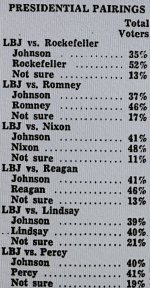
The polls were not showing much good news for the Johnson-Humphrey ticket in 1967 as the below clipping shows.


IMG_4307.jpeg


But there may have never been a year - certainly not in the television era - with more halting ups and downs and course reversals than 1968 would present.

Note: there will be a pause here as I'm reading two more books on the 1968 election during posting
 
Last edited:
  • Like
Reactions: Huckleberry
GEORGE WALLACE COMES OF AGE

There was another name certain to be in the race in 1968, former Alabama Governor and current First Man George Corley Wallace. Elected as a Democrat in 1962, Wallace's stirring declaration in his inaugural speech of "segregation now, segregation tomorrow, and segregation forever" followed by his infamous "stand in the schoolhouse door" and his later success in the 1964 Democratic primaries had turned him into a national figure almost overnight. When Wallace was limited to nonconsecutive terms as he approached the end of his elected tenure, he shamelessly declared he'd run his wife for the governor's chair - and he would be making the decisions anyway. This was his fallback strategy after he attempted to get the state legislature to change the rules. Lurleen Wallace was elected, and she handled the typical Vice-President of the US duties like attending funerals and ribbon cuttings while George basically continued to function as the state's chief executive.

One of the biggest misnomers both in the 1968 election and still today is that George Wallace was some sort of populist conservative. One might argue that is true on the issue of civil rights, but Wallace was a typical Democrat of his time, an unreconstructed New Dealer who spent more public money in Alabama than any of his predecessors, much of it on public welfare but also for community colleges. Wallace's voters were more likely to be traditional Democrats (e.g. not merely the Southern Democrats) than they were to be conservatives (cf. Cohen, 264). And Wallace was no dummy. He knew full well there weren't enough people who would "vote racist" across the USA to ensure he could win a national election, so he set out to build his own coalition. And as the candidate of the American Independent Party, Wallace will never be confused with Ronald Reagan as far as where he wanted money spent. Wallace called for "more job training for ALL Americans" as well as increased government spending on transportation, education, NASA, and a significant increase in Social Security benefits and "medical care for the aged" (now called Medicare). Wallace's politics were so traditionally liberal in the 1960s that civil rights leader Julian Bond once remarked (jokingly) that Wallace "confused" him because "he's a liberal on a great many questions - except race." Indeed, one could almost argue that Wallace mouthed the rhetoric of the right and had the spending proclivities of the left. And like most liberal Democrats of the 1960s, he was also staunchly anti-Communist.

Cohen debunks the flawed assumption that "the Goldwater voters were the Wallace voters" as if there was some sort of racist connection. There was, but it was far less than assumed. Goldwater DID gain the racist vote of the South in 1964 as the last gasp of fit throwing over the Civil Rights Act, but many of those voters had moved on by 1968. Goldwater did well among the "well off" voters who would typically have voted Republican anyway while Wallace carried the votes of and declared himself the champion of the working class. There was, however, a strain of racism that ran through some of the voters simply because some did see Wallace as the kind of President who would spend a lot of money - but on THEM, not necessarily minorities.

A lot of Wallace's rhetoric heard today - and particularly the rhetoric of Wallace voters who were quoted for attribution - sounds eerily similar to the comments made by President Donald Trump. Wallace declared that "a small minority of people" were responsible "for the breakdown of law and order", and that if you got rid of that criminal element, we could all live in peace and harmony. Wallace had a very simple solution to the riots that blanketed the country in 1965-67: "The people know the way to stop a riot is to hit someone on the head." In general, his voters were conflicted on Vietnam like much of the country. They really didn't want us there but may as well go win it since we were there (Wallace said as much). But he aimed his rhetoric towards the protestors, saying "they should be dragged by the hair on their heads and stuck under a good jail." When a protestor lay down in front of President Johnson's limo, Wallace was fast to quip, "If a group of anarchists lay down in front of my automobile, it's gonna be the last one they ever wanna lay down in front of." Spiro Agnew and Ronald Reagan, both elected governor in 1966, at least had the common sense and political acumen to distance themselves from the segregationists and John Birch Society. Wallace relied on the Birchers for his political muscle throughout 1968. Wallace was a terrible campaign organizer - but he was one helluva fundraiser, too, back at a time when that was less important than it became after the McGovern-Fraser Commission finished changing American politics for the worse in 1972.

It should also be noted that while Wallace himself never uttered "the" racial slur of slurs during the campaign, it didn't prevent his audience from doing so. Wallace held rallies where riots broke out, later deemed to be "a feature, not a bug" of Wallace's campaign. And lest anyone think such episodes were limited to the rural South, Wallace visited what is now Cranston, Rhode Island on July 25, 1968, protested by demonstrators while his own supporters shouted phrases such as "Sieg Heil!", "Kill the (n-word)s" and "throw the (n word)s out!" Wallace was attempting to cleave together the spending of New Deal Democrats with the racist rhetoric of Southern Democrats while running as a purported Independent. And Wallace was never under any delusions that he was going to be able to carry enough states to win the Electoral College. But he could also become the kingmaker by throwing the race into the House of Representatives, too.

In 1962, Wallace had gone on the record for segregation. In 1968, he would seek the White House with a slogan declaring, "Not a dime's worth of difference" between Richard Nixon and Hubert Humphrey. Given the eventual final vote - Nixon won by a little less than 512K popular votes and only won the election because he carried his home state of California by a narrow margin of 3 points - it might be argued more Americans agreed with Wallace on that one subject than agreed with anyone on anything else said in 1968.

Next up: how Nixon won the GOP nomination.
 
  • Like
Reactions: Huckleberry
NIXON THE NOMINEE

The events of 1960 overshadowed the Republican race for 1968. After winning the New York gubernatorial election in 1958, Nelson Rockefeller by virtue of his position became a potential future Presidential candidate. At the time, New York had more electoral votes than any other state and no fewer than 11 previous New York governors - George Clinton, Daniel Tompkins, Martin Van Buren, Horatio Seymour, Samuel Tilden, Grover Cleveland, Theodore Roosevelt, Charles Evan Hughes, Al Smith, Franklin Roosevelt, and Tom Dewey - had been nominees for President or Vice President. But Rockefeller made the first of a series of mistakes decision-wise that would haunt his political career when he decided in December 1959 to not contest the GOP nomination in 1960. Rockefeller failed to realize that withdrawing so early sacrificed any and all leverage he might have with the party. He then proceeded to earn the enmity of almost every Republican office holder in the country when the Soviets shot down a U-2 spy plane flown by Francis Gary Powers in the spring of 1960. When he criticized President Eisenhower - and by implication his successor, Richard Nixon - with a nine-point complaint about foreign policy, he was ridiculed as someone who needed to be seeking the nomination of the Democratic Party instead. Rockefeller then proceeded to corner the centrist Nixon into agreeing to some minor points of change to the party platform - called "the Compact of Fifth Avenue" - that made Rockefeller look intrusive and Nixon look weak. Barry Goldwater followed with a reaming of the party's conservatives at the national convention, telling them they needed to grow up, support Nixon in 1960 and someday maybe the right wing could "take this party back again." Throw in his 1963 divorce and remarriage followed by the 1964 birth of his child - the week of the California primary no less - and Rockefeller was barely tolerated inside party circles. He then made it worse with his blasting of the party not repudiating extremists at the 1964 Convention. And then there was George Romney, who was being seen as a stalking horse for Rockefeller to steal the nomination.

After traveling the country like no "unelected" candidate previously, Richard Nixon took the attack from President Johnson - elevating his status - and then announced he would take a sabbatical from politics the first six months of 1967. His stated reason was the need for a break, which was probably true. His real reason was to let Romney walk into the line of fire of the press and get himself in trouble. If you want a modern visual of Romney, think of a candidate with the general decency and religiosity of Joe Liebermann but handicapped with the speech patterns of Dan Quayle, and you have a pretty good idea. Romney's plan to become President was simple, so simple it has been tried and (usually) failed numerous times since then by such candidates as Edmund Muskie, Birch Bayh, John Glenn, Bob Kerrey, and Howard Baker......and yes, Mitt Romney, his son. Win a state where the other party is dominant - multiple times if possible - make an asset of that choice, position yourself in the center of the center, and reject extremism. But his biggest problem was one he could never hide: the guy was a walking gaffe machine, one right after the other. Jack Germond, who later became famous as a panelist on The McLaughlin Group once wrote a column where he claimed to have had a special key installed onto his manual typewriter that would print out, "Romney later explained." And on no issue did Romney do more explaining or suffer more damage than the Vietnam War.

Johnson thought Nixon was the easiest candidate to beat, so he had every inclination to destroy Romney early. In April 1967, Romney plunged into the thicket without a road map and gave a speech of generalities that said nothing at all. In fact, all the speech really said was what Romney would NOT do. Johnson sought to undercut Romney by pointing to the speech and using portions of it to say that Romney had given a strong endorsement to Johnson's approach to the war. On the last day of August 1967, Romney sat down for an interview on a local Detroit news show and when the host asked him about his recent statement that the US shouldn't be "involved at all" in Vietnam, Romney appealed to his 1965 tour of Vietnam and said that while there he had been subject to "the greatest brainwashing that anybody can get," not just from the military generals but also the diplomatic corps.

If you think the Katie Couric interview with Sarah Palin was a disaster, well, this one was worse. Palin at least made it to the finish line, but this one interview more than anything else destroyed Romney's candidacy even worse than Ted Kennedy's 1979 interview with Roger Mudd did his. Kennedy at least won a few primaries. Romney's gaffe was so bad that the Detroit News retracted their Presidential endorsement of him, calling for Nelson Rockefeller to save the GOP.

The problem for Romney is a basic one in American politics and occurs when a question hanging in the air around a candidate is reinforced, often with one easily recalled punchline. It happened to President Ford in 1976, when he declared Poland was not under Soviet domination, a blunder that may well have cost him the election. It happened when Gary Hart was caught fooling around and when Joe Biden was caught plagiarizing in 1987. It occurred when Lloyd Bentsen delivered the death blow to Dan Quayle's electoral career by telling everyone he "was no Jack Kennedy." It happened when Howard Dean issued his infamous "scream" in 2004. One could plausibly argue it happened when Hillary Clinton couldn't handle basic questions around an email server in 2016. Something happens that reinforces something negative about a candidate that is already a question out there - and they're never the same again. The "brainwashing" episode is, to this day, the first thing anyone who even remembers George Romney's campaign for President references.

But there was more.

In the last four months of 1967, Romney made so many verbal slip ups that it almost seemed he was trying to lose. In response to some Jordanians on the Six-Day War, Romney referred to the West Bank as "Israeli territory". He then went to Vietnam for Christmas Day and gave a message - on Christmas Day, mind you - of sacrifice, saying, "Some of us have to lose our lives young, and some of us when we are older." He capped this fluff by asking a wounded soldier who had just received a tracheotomy in a field hospital in Da Nang, "I'm George Romney, where are you from?" Probably the most remembered visual was when Romney visited a bowling alley in Franklin, New Hampshire on January 15, 1968, just two months prior to the primary vote. Romney tossed a bowling ball down the alley and knocked down 9 pins with the first roll. Filming for use in a commercial, he decided to pick up the one-pin spare by tossing another ball. And another. And another. It took Romney 39 tosses of a bowling ball down the alley to knock down the last remaining pin. With his campaign imploding all around him, Romney saw the writing on the wall and left New Hampshire, withdrawing on February 28 before the first ballots were even to be cast. That left Rockefeller to try and win it on his own - and the "the rising star of the West" by Newsweek magazine, Ronald Reagan. To be sure, two other candidates - Illinois Senator Charles Percy and NYC Mayor Lindsay - had been mentioned as possible nominees but neither had the name recognition of Nixon, and Reagan would be lucky to score in the single digits in New England anyway. Rockefeller's problem was he had to figure out a way to get the straight-laced New England conservatives to take him as an alternative to Nixon. This had worked against Goldwater (for Henry Cabot Lodge) in 1964, but Nixon was no extremist. Rockefeller decided to wait until the Oregon primary, which he'd won ion 1964, to take on Nixon but the party rules mandated that if he competed in Oregon, he also had to compete in Nebraska, which was a surefire loss. What made Rockefeller withdraw from the race was Bobby Kennedy's entrance four days after the New Hampshire primary. Confused? I'll explain.

When RFK announced his entry into the race, it was crucially timed to put him on the later primary ballots. But it was a day late - supposedly - for the Nebraska race, and RFK felt he had no chance there. But sure enough, the one day delay was set aside and RFK was placed on that ballot, too. Nixon was there to remind everyone that if Rockefeller jumped into the race in Oregon, the precedent had already been established that the deadline didn't mean anything at all. Seeing the writing on the wall, Rockefeller threw his cards in and folded on March 21.

It's worth noting that Nixon was sitting on a hot story that may have forced Rocky's hand: rumors had circulated for months that this guy who had left his wife of 30 years just prior to the last campaign was involved with another young lass, and the media was prepping to bomb him with the story upon his announcement. Rockefeller withdrew and now Nixon's only remaining barrier was the Southern United States. And thus "the southern strategy," a misnomer in several ways.

The term has come to almost exclusively mean the sinister suggestion that by employing racist dog whistles and innuendo on race, Republicans gain white votes that once belonged to Democrats and win the election. In reality, the words have a multiplicity of meanings and anyone who wins the South as a bloc of votes could be said to have employed a Southern strategy. (Go look at the electoral map for Jimmy Carter in 1976 and explain otherwise). That Nixon had to worry about the South FOR THE NOMINATION is without question. That he ran a racially coded election based on dog whistles that captured the Goldwater voters, you're gonna have to give me some actual evidence this happened. (But we'll get to that in a later post).

Rockefeller had one card left to play against Nixon in order to win the nomination: he needed the South to line up behind Reagan, whom they adored, split the party vote on the first ballot and then be seen as the most logical person to unite the party and win in November. Reagan, ironically, had the exact same strategy, but he had something going for him Rockefeller did not: a realistic chance of winning the Southern Republicans, who cast over 1/4 of the delegates needed to clinch the nomination. It was at this point that South Carolina Senator Strom Thurmond - the most well-known name of a party switcher in the country - took Nixon aside and told him the Southern delegations would need reassurance before the vote.

Nixon had met with Thurmond in Atlanta on June 1 in a well-reported meeting and, of course, given Thurmond's prominence as the racist head of the States Rights Party of 1948, the assumption was always that Strom was holding Nixon by a string on race. But there is literally not an ounce of evidence to even suggest it. Thurmond himself said he told Nixon to hold the line against Communism. Bear in mind given the Soviet invasion of (then) Czechoslovakia through much of 1968, this is easily believable. Nixon had gone south in both 1965 and 1966 and endorsed the new civil rights laws, saying that the GOP needed to not line up with segregationists like George Wallace and Lester Maddox. Nixon said a variation of this message in all 11 states of the Confederacy in those two years, hardly the tactic of someone trying to appeal to racist white voters. He spelled out his own support for the softer 1957 Civil Rights Act that he and Johnson helped moved through the Senate. It should be noted at the same time, however, that Nixon also had gone to South Carolina in 1966 and declared Thurmond "not a racist," which hardly sounds reasonable even in 1966. But Nixon knew how to play the political game like Machiavelli, too. So he did, in fact, cozy up to Thurmond - not to win the general election but to win the nomination where the South had an outsized say.

Nixon played a smart divide and conquer strategy with the Southern delegations. He promised them he would not pick a VP nominee that would split the party, which they chose to hear as disqualifying Mark Hatfield, whose name was high on the list. He didn't take a categorical position on busing except to note - as George Wallace had so many times in 1968 - "it's a problem in the north, too." Nor would he retract his support for open housing legislation that he had supported publicly, although he hedged on this by saying that he supported politics at the most local level possible. The conservatives chose to hear this as "I only voted for it to not be seen as a racist" and the moderates chose to hear this as "I really support this but I have to hedge my bets to be the nominee." Who knows, maybe both were right. Taking categorical stances is rarely the strong point of any person who actually manages to get elected President. Among his other promises - to the South and the nation as a whole - were to get a new Attorney General (hardly an earth shattering promise since every President names one) and Supreme Court justices with more sympathy for the victims than the criminals.

Cohen points out that Nixon's word shadings were incredibly effective and allowed his viewpoints to be seen as a blank slate. Then again, Nixon had this luxury: he wasn't the Vice-President of the United States stuck with Johnson's record, and he wasn't a racist interloper without party support. And nowhere was Nixon more clever than on the most important subject of 1968, the Vietnam War. He had been scheduled to deliver a speech to spell out some details in March but when he got word that President Johnson was giving what turned out to be his withdrawal speech, Nixon sat on it. And despite the now infamous urban legend that Nixon announced in New Hampshire he had "a secret plan" to end the war, he never said any such thing. (You can cite all the websites and reporters you wish - do a little deep diving and you'll find out that YES, Nixon DID say in Hampton, New Hampshire on March 5, 1968 that "new leadership" was required to "end the war in Vietnam," but he did not say (as Jack Germond repeatedly claimed and as Godfrey Sperling and others have erroneously repeated) that he had a plan that had to remain a secret until after the election. Once Johnson withdrew - and claimed it was in part to handle the war - Nixon would have been a fool to spell out anything and accused of trying to sabotage the peace if he had said some things. (I'll touch on the Nixon attempt to do just that later as well). In fact, in an article published March 28, 1968, the Los Angeles Times said the EXACT OPPOSITE, reporting that Nixon addressed the notion, saying he had “no gimmicks or secret plans” for Vietnam.

Nixon wound up winning the nomination and as his running mate he chose a man who at the time was unknown but whose sole asset beyond his anonymity was the fact he was one of the few Republicans from near the South that SUPPORTED federal open housing law and had beaten a segregationist in his race in 1966, Spiro T. Agnew. Thus, the apparent "racist Southern strategy" of Richard Nixon in 1968 involved choosing a man who supported civil rights and open housing when it wasn't yet the norm, going south and saying he supported the new laws of 1965 and 1966, and leaving the Deep South to Wallace while trying to win the border states he had already carried three times previously. Yes, Nixon touched on the subject of "law and order," which will also be covered later.

As for Agnew would not remain an unknown for very long.

Upon conclusion of the Republican National Convention in August 1968, Richard Nixon led Hubert Humphrey in the polls in no less than 46 states. So much carnage is in the Democratic nomination that it will take a few posts to lay out the groundwork.
 
Advertisement

Trending content

Advertisement

Latest threads