USFL vs NFL Lawsuit: 1986 Redux

selmaborntidefan

TideFans Legend
Mar 31, 2000
42,453
41,604
287
56
Beginning May 12, we enter the 40th anniversary of the infamous USFL vs NFL lawsuit, an event that was (largely) the first to make most Americans outside of New York City aware of whom exactly real estate developer Donald Trump was. Although I did provide a large overview of the lawsuit at the end of the first Trump administration. In the recent upgrade, however, that thread has been lost to the online Gremlins. (Fortunately - it was one of the few posts where I saved the content in a WORD document). Thus, I'll recap - and revise (as always) - where it needs to be modified with either more recent findings or due to my own irresponsible verbiage. If anyone has questions because of a statement I make that is open-ended or open to interpretation, feel free to ask here because someone else probably has the same question.

There are a couple of outstanding books that cover various details of the USFL:

1) "Football for a Buck" by Jeff Pearlman (2017)
2) "The $1 League: The Rise and Fall of the USFL" by Jim Byrne (1987)

One can also read some incredible propaganda of half-truths by reading chapter 11 - I'm absolutely serious - of Trump's "autobiography," entitled "The Art of the Deal" (1987).
 
  • Like
Reactions: dtgreg
The USFL (United States Football League) was a dream in the mind of a guy in New Orleans in 1961 who was angry the NFL had not expanded to his city (David Dixon). When the NFL added a franchise in New Orleans in 1966, Dixon set his plan aside, but he had told the legendary Paul Brown about his idea, and Brown told him - "This is a great idea. This will work."

In May 1982, the USFL announced they would begin playing in the spring of 1983, and they came up with a few ways to attempt to help the league get through what promised to be the lean early years: spring ball, limited costs, a fake draft (teams got players because of their region, and the attempt to make the sport more fun than finances. They would put teams in cities that didn't have NFL teams where possible. Thus, the Birmingham Stallions, Memphis Showboats, Arizona Wranglers (the Cardinals would not move there until 1988), and Boston Breakers (the Patriots played in Foxborough even then) were put on the field alongside teams in the three largest TV markets in the USA, the Chicago Blitz, the Los Angeles Express, and the New Jersey Generals, a team placed there in proximity to New York City.

The USFL caught their first break when the NFL players went on strike after week two of the 1982 season, which would add to the hunger for more football. But their attempts at "controlled costs" went sideways when the New Jersey Generals owned at the time by Oklahoma oilman J. Walter Duncan (NOT Donald Trump) signed Herschel Walker to an insane contract in an effort to give the league instant credibility. The league as a whole was going to supplement Walker's salary as an instant investment. The team was not very good that year, going 6-12, but the USFL championship game between the Michigan Panthers and Philadelphia Stars was just as exciting as that year's Super Bowl and drew the highest rating the league ever would. The league lost money - as expected - but the future at the moment seemed bright.

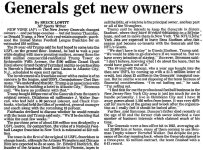
Then on September 22, 1983, a heretofore unknown real estate developer bought the New Jersey Generals, overpaying for the team by somewhere between $2-4 million.

He wouldn't stay unknown for very long.

Trump Buys Generals.JPG
 
  • Like
Reactions: dtgreg
Personal note:
My apologies for the delay.

I've been in a lot of pain the last couple of weeks and am seeing a doctor.
Probably just getting old.

BEFORE THE TRIAL

The USFL (United States Football League) was a dream in the mind of a guy in New Orleans in 1961 who was angry the NFL had not expanded to his city (David Dixon). Because they got the Saints plus other
reasons, the dream got put on hold. When the USFL announced it would start playing in the spring of 1983, they came up with a few ways to try and survive: spring ball, limited costs, a fake draft (teams got players because of their region; for example, Alabama and Auburn players were
automatically assigned to the Birmingham Stallions franchise), and just good fun.

May 11, 1982 - The United States Football League is founded by promoter David Dixon, with 12 teams: Washington Federals, Philadelphia Stars, Boston Breakers, New Jersey Generals, Tampa Bay Bandits, Chicago Blitz, Birmingham Stallions, Michigan Panthers, Los Angeles Express, Oakland Invaders, Arizona Wranglers, Denver Gold.

May 26, 1982 -- ABC awards the new league a 2-year, multimillion-dollar contract. The contract calls for the league to maintain franchises in or near the three largest cities in America: New York (the Generals), Chicago (the Blitz), and Los Angeles (the Express).

June 14, 1982 -- Chet Simmons, head of ESPN, is named first commissioner.

July 27, 1982 -- Plans are announced for expansion to 18 teams in 1983.

September 20, 1982 - the NFL calls the first player's strike in league history. The 57-day strike is largely a failure as seven weeks' worth of games are lost, the players get absolutely nothing, and they return to work for the games of November 22.

Jan. 4, 1983 -- First college draft; University of Pittsburgh quarterback Dan Marino is picked first by the Los Angeles Express.

Feb. 22, 1983 -- New Jersey Generals sign Heisman Trophy winner Herschel Walker of Georgia. The LEAGUE paid Walker's salary, and for the record, the owner was J. Walter Duncan. Trump has made many blunders, but he had nothing at all to do with the signing of Herschel Walker.

March 6, 1983 -- First regular-season games are played.

July 17, 1983 -- Michigan beats Philadelphia, 24-22, in the first USFL championship game.

It is here we pick up what exactly Trump did to this league that was truly unbelievable.

It should be noted Trump WAS, in fact, offered the change to be the original owner of the New York franchise. He called into the league conference call - about 30 minutes late - and said he couldn't be part of their "little project" because he was "opening a casino" and "big bucks" and that. That's when the Oklahoma-based Duncan agreed to be the New York-area owner. Just to show how smart Trump is, he paid $10 million for a football team that Duncan got with little more than a $1.5 million line of credit, meaning the oilman clobbered the Big Tough Man from the Big City financially.

1983

September 22
- Donald Trump calls a press conference in Trump Tower and announces himself as the new owner of the New Jersey Generals. He immediately starts saying some pretty crazy things, one of them being "NFL players are willing to sign for us for LESS than they are making in the NFL!"

September 29 - Trump's spokesperson (John Barron) calls William Wallace at the NYT, who publishes a story that Trump (an owner for one week remember) wants the USFL to move to the fall and compete directly with the NFL, declaring some of the USFL teams right now could beat the NFL teams, and maybe they should play a championship game with one another, declaring it would only take "2-3 years to achieve parity with the NFL."

October - The month begins with the eccentric Colts owner Bob Irsay (a man who six months later will move the Colts out in a fleet of Mayflower moving vans in the middle of the night under threat of court order) saying that Trump had offered to buy the Colts, which Irsay wasn't even selling. Trump then gets word out that he has talked to Super Bowl winning coach Joe Gibbs and GM Bobby Beathard about running the Generals. When both turn him down, Trump declares, "Well, we didn't think they'd make the right team for us anyway."

Trump then announces he wants NFL legend (and Dolphins coach) Don Shula to be his head coach. Shula's contract is due to expire on February 28, 1984, and it's no secret that Shula and Dolphins owner Joe Robbie aren't exactly the closest guys. Trump stalks Shula for weeks, calling him every Monday. Jeff Davis's outstanding biography "Rozelle" (published in 2008 and therefore hardly an anti-Trump hit piece based on politics)

Peter Hadhazy, who died in 2005, was interviewed for the Rozelle biography, and having an inside seat at what happened in the Shula hunt, he told the story. Hadhazy said he needed to offer Shula a million bucks to become the head coach of the Generals. Hadhazy was the go-between to give Shula plausible deniability since he did not want the negotiations to make it into the newspaper. Shula was interested - who wouldn't be in a million bucks in 1983 - and began asking about real estate and schools. Shula's BUSINESS MANAGER (not Shula) then asked that if Shula came up for the negotiation, would he be permitted to use an apartment in Trump Tower. Trump approved this - for usage if he was in the city, not for purchase or rent, etc. The plan - per Hadhazy - was to get Shula's name on a signed contract, hide it from the media, and then produce it at the last minute when Joe Robbie decided he was going to sit down with Shula.

Naturally, Donald Trump couldn't keep his mouth shut and went boasting to the media without a signed contract that he had Shula locked up. That's when he concocted the lie that Shula had requested a condo in Trump Tower as part of his salary. Shula basically told Trump to get bent, and Trump blamed Shula for the entire thing.
 
Trump's name is then linked to sports agent Howard Slusher. Trump naively announces that he's interested "in any free agent Slusher has," which inspires Houston Gamblers owner Jerry Argovitz to point out publicly that Trump doesn't seem to know anything about the monetary value of football players, and that he tips his hand too soon and sacrifices leverages in his dealings. About this time, Trump basically says he's given Don Shula two weeks to decide if he wants the coaching job or not.

That very same week, Trump appears on NBC's pregame show as well - which wouldn't be all that bad except Trump and Slusher had either been negotiating/playing each other, and Trump says he never had any interest in Raiders backup QB Marc Wilson, whom he flippantly dismisses as "just a second-stringer." Trump then boasts that he's outplayed Al Davis, the Raiders' maverick owner. Because the Raiders have a Monday night game, Wilson sees this insult on the TV coverage and says that Trump is lying.

Howard Balzer ("The Sporting News") reports that in his six weeks as an owner, Trump is continually having to save face and seems more interested in media publicity than actual results, citing the debacles with Shula and Wilson.

Don Shula then comes out with his side of the story, saying that Trump wanted to meet with him when the Dolphins were playing the Jets in Jersey a few weeks earlier. Shula says Trump is "an interesting man" but "there's no way he's going to be pressured" at this point. After Trump's appearance on "NFL Today," Shula then says that Trump has misrepresented how close Shula ever was to coaching the Generals. It should be noted, however, that when Shula was specifically asked whether he demanded the apartment in Trump Tower, he dodged the question, saying only that "many things were discussed." Trump's office immediately goes into high gear, saying that Trump rejected Shula first and gives what becomes standard Trump litany: "You know that he was interested. I guess he was a little upset when the apartment thing came out. Don is a good man, an excellent guy really, and I wish him all the best." (That verbatim quote is from the November 7, 1983 edition of "The Sporting News" on page 21 as reported by Larry Dorman).

November 1 - the Dallas Times Herald reports that Trump has made an offer to Cowboys defensive player Randy White - a $400,000 signing bonus and a $700,000 per year salary beginning in 1985. It's impossible to tell whether this is a negotiating ploy by Slusher or an attempt at getting attention by Trump. Trump denies any interest in White while Dallas GM Tex Schramm basically says it doesn't matter what Trump does, he's just out for attention.

November 6 - on the NBC pregame show, host Len Berman (six weeks behind the times) says, "Donald Trump predicts parity with the NFL in two to three years!" Larry Felser, the NFL beat writer for "The Sporting News" does a story on Trump, who nobody even knew outside New York six weeks earlier - his boasting about how Americans cannot afford his apartments, that he's worth $200 million, that "everything I touch turns to gold" being the reason his Dad made him President of the family real estate business. Felser then came with both a report AND a warning - in his first appearance on NBC, Trump had declared the USFL's future course should be to "challenge the NFL directly in the fall." Felser then pointed out - among other problems - that not one commentator seemed to be intelligent enough to ask him which TV network was going to air their games since the NFL had contracts with the 3 major ones or how in the world cities with teams in both leagues (Tampa, Philadelphia, Detroit) were going to share the same stadiums at the same time. Felser further warns that Trump's suggestion that Shula had petitioned him about coaching in Jersey was ludicrous, noting that with six Super Bowl appearances, "If Don Shula ever wanted to change jobs for more money, he wouldn't have to distribute resumes or take out an ad in the classified section."

November 8 - Cleveland QB Brian Sipe (the 1980 NFL MVP but 34 years old) meets with Trump about switching leagues. After that meeting, Trump suddenly announces he's interested in a different QB, Denver Broncos starter Steve DeBerg (who everyone already figures is going to lose his job to John Elway in 1984). Problem? The Denver Gold hold DeBerg's rights. Jim Gould, the Generals spokesman, then comes out with a Trump sounding comment, "I don't think he'd like to play for any team in the USFL other than the Generals." The Gold accuse Trump of tampering.

Late November - Don Shula signs his new contract with the Dolphins. In a parting shot at Trump, Shula says that Joe Robbie's hardest selling point was agreeing to throw in "a one-bedroom efficiency apartment on Biscayne Boulevard," which elicits a number of laughs. Meanwhile, the Generals sign Brian Sipe and Steve DeBerg suddenly has nowhere to go. Two other coaches are rumored as the new Generals coach - Joe Paterno (Penn State) and Howard Schnellenberger (on his way to Miami's first national title at that time). Trump settles on recently fired Jets coach Walt Michaels, convincing himself that Michaels is popular among people in New York because the Jets fired him after coming within one half of Super Bowl 17.

December 6 - Trump has lunch with third-year NFL linebacker Lawrence Taylor, who still has 3 years on his contract. Naturally, Trump tells the press he's negotiating with LT. Trump has already done this with both Shula and Sipe. Talk to them, tell them to keep quiet and then Trump calls the press and tells them what he's doing.

December 14 - Trump wires one million dollars (yes, he really did) to Lawrence Taylor's account. It's a "25-year interest free loan" to a kid who grew up poor. Taylor signs a contract to play for the Generals starting in 1987. Trump assures Taylor that word of the contract will never get out and then calls the major NY papers and tells what has happened, using his (fake) spokesperson, John Barron. It should also be noted this is a violation of the agreed upon USFL rules since Taylor is in the Philadelphia team's geographical area for draft choices. USFL commissioner Chet Simmons figures no harm will come anyway because he doesn't for one second believe that Taylor will ever play for Trump.

At the end of 1983, the Giants are in the doldrums (Parcells nearly quits after one year, Taylor is rumored out when his contract is up). In just over 3 years, the USFL will cease to exist as the Giants become Super Bowl champions.

As we enter 1984, we find Trump already to be a bit of a loose cannon, sorta of a Jerry Jones back in the early 90s when he began thumbing his nose at NFL ad deals and free agency rules.
 
  • Like
Reactions: dtgreg
1983

December 27 - the worst-kept secret in sports comes out when the officials for Trump's New Jersey Generals announce they have signed Cleveland Browns QB Brian Sipe to a contract, and he will be the starting quarterback. Sipe has been bothered by a sore arm and being 34 years old, he signs a GUARANTEED three-year contract worth $2 million. The Browns had offered him $2.2M without a single guarantee of one cent. Sipe is signed without even so much as a physical. Browns coach Sam Rutigliano says this truly bizarre fact is only possible because "that's consistent with an owner (Trump) who has yet to attend his first professional game" (as owner).

1984

Early January - Trump lets it be known that he wants a stadium in New York. Conveniently for Trump, so does the city of New York in hopes of luring either the Giants or Jets back to the state. According to Pearlman, Trump's dream is a fall football team playing in state of the art Trump Stadium right there in Manhattan. Trump DOES say at this time, "I don't think anybody in the country has achieved more credibility than me in a business sense in the last few years." (This is the broken syntax of an Ivy League grad???). But he's still second to Yankees owner George Steinbrenner, and he knows it. On the day Trump intended to to hire the new Generals coach, Steinbrenner called Trump up and told him that he was firing Billy Martin that day, and Trump might want to move his press conference if he wanted any coverage, with Steinbrenner reminding him who the Big Cheese in New York really was with a Trumpian sounding remark - "remember, you're the new kid in town."

Trump also dismisses Brian Sipe's "sore arm" as little more than a negotiating ploy by the Cleveland Browns. Saying that Sipe is "too much of a gentleman to say it, but I'm not," Trump says that the "whole business" of Sipe's "sore arm" was only because "he was seen at Trump Tower" Trump then accuses the Browns of benching Sipe and making up the story about the sore arm. At the same time, Trump says publicly that the USFL should just drop their contract with ESPN. NFL analyst Paul McGuire (who had gone through the AFL-NFL merger and knew a thing or two about it) - then on ESPN prior to his move to NBC - retorts that Trump basically needs to learn he isn't going to build a league individually and maybe he should either think before he speaks or get someone to write it down for him first.

January 9 - Sports on TV critic Jack Craig writes a devastating column in "The Sporting News" to serve as a warning to Trump, in particular, and the USFL in general that going to the fall will be absolute suicide. Building his argument both structurally and logically, Craig basically notes that the NFL is reaping a harvest from the TV guys for the very first time, a contract that lasts into 1987 and sees the numbers go up every single year. Craig notes it is a classic "Catch 22" situation - because even assuming Trump's wildest notions are all correct, what will actually happen (to people who understand business) is that BOTH the USFL AND the NFL will see a decrease due to over-saturation and the other (less obvious problem) that fans are only fans of the USFL when there are not NFL games currently going on. The Tampa Bay Bandits cannot compete with the Buccaneers, regardless. Craig points out that even in an absolute best case scenario, the USFL is not going to reap some financial gold mine by moving to the fall.

January 11 - Trump meets with Lawrence Taylor's lawyer to see about getting LT out of his future contract with the Generals. Trump uses his leverage wisely this time, eventually getting all of his million dollars back from Taylor along with some interest rumored to be paid by the Giants. In exchange, Taylor's contract is extended through 1989.

January 17 - on the day before the USFL meetings open, Trump settles the Lawrence Taylor issue and makes a nice little profit aside from getting attention.

January 18 - Trump arrives at the meeting and tells the other owners that the thus far successful league had "been going downhill until I arrived." He then declared his buying the Generals had completely changed the perception of the USFL from one of failure to one of success. His very next words were his launch of a nuclear bomb - the USFL needs to move to the fall RIGHT NOW and "directly challenge the NFL." He follows this with a rant about "not being a loser" and boldly declaring, "I will produce ABC, CBS, and NBC" for "more money than you're making now!"

To appease Trump, a study group is formed to discuss the feasibility and likely outcome of a move to the fall.

January 23 - right alongside stories of the Raiders' 38-9 demolition of the Redskins are stories of the possible USFL move to the fall. Trump's name is the dominant one, but the NFL isn't happy. Art Modell offers the take that while he has no problem with negotiations and players, it was absolutely absurd for Trump to be calling Sipe in the locker room while the NFL season was ongoing.

February 6 - James Gould, one of the USFL's co-founders and a public face on the rare occasions Trump doesn't insist on being the mouthpiece, announces he's leaving the Trump Organization to start his own business.

February 16 - Wayne Byard, a sportswriter for "The Winchester Star" (Virginia) predicts that with Trump leading them into war, he would give the USFL "two more years at tops."

February 26 - the USFL kicks off their second season, Trump's first as a team owner. The Generals beat the Birmingham Stallions, 17-6, at Legion Field. At the time, the opening game attendance of 62,300 fans is a league record, which Trump unabashedly takes credit for causing (the fact his team was the visitor in the most rabid football state in America who had several college players on both teams seemed lost on him).
"It's big this week, and it will keep on going up It will get bigger next week and it will be the biggest yet two weeks from now!" Trump says in reference to the upcoming opener for his team in Jersey.

At halftime, Trump and Stallions owner Marvin Warner are interviewed. Trump compares the crowd to the crowd at the recent Tampa Super Bowl, implicitly saying the USFL's 62,300 fans for an opener is great by comparison with the Super Bowl, which drew 72,920. Trump did not trouble himself with the fact Legion Field still had 9,000 empty seats while Tampa was sold out, but details are not a Trump strength.

Sports coverage focuses on the fact that the USFL has gotten a lot of ink since Trump began running around the country and signing up a bunch of NFL players that were either past their prime or that nobody wanted - and the name familiarity lifts the league's profile. But the league is largely considered to be minor league football with a few names. A few sportswriters are willing to say that Trump has basically violated every single promise the league made when it began in 1983 - from crossing over into other team's school territories to spending way above acceptable limits.

March 1 - a key moment underscoring the problems with the USFL occurs when ABC asks the Generals and Jacksonville Bulls to reschedule their Friday night game to Sunday so it can be carried on national TV. The reason is obvious: none of the teams are a national draw to the extent the Generals are; indeed, most fans don't really care. The crowd increases to over 73,00 in the Gator Bowl to see the Generals eke out a 28-26 win.

There's also a ruling that the USFL's practice of not permitting college players with 2 years of eligibility remaining violates antitrust law. The NFL was not named in the suit, but this creates another potential nightmare situation that becomes immediately suspected - Trump scouring college campuses and making players ineligible to help coax them into the USFL.

March 7 - the NFL ups the ante by suggesting that since his contract will expire after the 1985 summer USFL season, they may allow NFL teams to draft Herschel Walker in the 1985 NFL draft in April. Trump then bungles the response, first saying he wants Herschel to sign a 4-year extension and then offering to guarantee all money even if the league goes under.

March 8 - Trump announces Walker has signed "for the rest of the decade." (So far as I can tell, he did). When asked if Walker's contract exceeds the value of new Los Angeles Express QB Steve Young's $40 million dollar contract (as an annuity and mostly a stunt), Trump declares that he knows numbers and Herschel has the "biggest" and "best" contract. There is more discussion of whether Walker has the better contract than the actual value of keeping him in the USFL, a notion seemingly lost on Trump.

March 11 - despite playing their first home-game against the best draw in the USFL - the Philadelphia Stars (who would play in all 3 USFL titles games) - Trump's Generals draw "only" 46,000 fans to their home opener.

May 12 - NFL commissioner Pete Rozelle has a meeting with Donald Trump in the Pierre Hotel in New York City mere hours after Trump suggested as meeting (both lived in NYC, so this was easy to accomplish quickly). Rozelle later testifies during the trial that his phone call with Trump that day is the first time he ever spoke to Trump. In the lawsuit, Trump later uses this meeting to claim that Rozelle is a longtime friend and that Rozelle offered him an NFL expansion franchise in exchange for not filing a lawsuit.


March 15 - the NYT runs the first specific report quoting two sources - one believed by outsiders to be Trump - says the USFL has already decided to move to the fall in 1987. Trump says that 2/3 of the league's owners agree with him and that if he had known the league had no plans to move to the fall he never would have bought the Generals. At this point, Trump has already tried to rename them New York and faced fallout from within the state.

March 23 - Trump bids to buy the Minnesota Twins baseball team. There is serious concern with keeping the Twins in Minnesota, and all the bids are from non-Minnesota potential owners, including Trump. Trump promises if he buys the team, it will remain in Minnesota. The sticking point that emerges later - since Trump does, in fact, have the highest bid - is that Trump won't commit to longer than three years in the land of lakes.

March 26 - rumors abound that Trump and his West Coast doppelgänger (William Olden, much older owner of the LA Express) are disappointed with USFL commissioner Chet Simmons and blame him for what are "terrible" TV deals. Simmons's past employment in TV at ABC is the sticking point, although the fact Simmons had zero to do with the TV deals doesn't stop the two from proposing that ABC sports announcer and self-important blowhard Howard Cosell replace Simmons as commissioner to help with new TV deals.

March 29 - a caravan of Mayflower moving vans loaded with everything they can take from the Baltimore Colts franchise escape by dead of night and move the Irsay family's longtime NFL team to Indianapolis. Trump has claimed he could have bought the Colts, who haven't even been for sale, on more than one occasion.

April 1 - an official at ABC says that Trump had requested that coverage of the his team solely refer to them as "the Generals" and drop the "New Jersey" designation. Trump denies it ever happened. It also comes out that Trump has had the name "New Jersey" removed from all the club's stationary and memorabilia, referring to them simply as "the Generals."

April 15 - citing "two prominent USFL executives," the NYT runs a second story saying the USFL is considering moving to the fall in 1987, including the known to be Trumpian words, "It's the only logical way for the league to continue. There's virtually no chance this will not happen."

April 16 - John Bassett, owner of the Tampa Bay Bandits, vociferously attacks the NYT story from the previous day, saying there is "not one ounce of truth" to the idea of the move to fall. He is joined by Alfred Taubman, owner of the champion Michigan Panthers, who also dismisses it. Both cite Trump as the source of the claim. Former NFL coach George Allen - at the time the Arizona Wranglers GM - says he hopes that it is true.

Spring/Early Summer 1984 - Pete Rozelle begins to prepare the media for a soon coming lawsuit from the USFL in an effort to either force a merger or a huge payout. The timing suggests Rozelle knew the meeting with Trump - which he would later testify Trump paid for the entire thing - was basically a setup to threaten him and the NFL behind closed doors.

April 18 - LA Express quarterback Steve Young stuns the entire world by saying he expects the USFL will implode - and that as a result the Express will join the NFL in the fallout. (Reminder - in 1984, Los Angeles had two NFL teams in town, and both were very good). Young basically says that he's looking forward to facing the competition in the NFL but playing for his current team. The remarks come at the worst possible time for a league in-fighting among itself. As a reminder, Young is 21 years old at the time, a millionaire, and planning to go to law school in his months away from the game.

May 14 - Dick Young, the nation's best-known (and most obnoxious) sportswriter pens a column for "The Sporting News" where he says Young's only mistake is that he's saying out loud what is obvious to everyone. Young then offers a prediction - there's no way Trump is going to get them to actually vote to move to fall simply because it would be committing league suicide and everyone knew it. He also predicted that the league would thrive as the summer alternative it was.

June 4 - The USFL is the cover story on "The Sporting News," with the question "Will It Survive?" Analyst Larry Felser covers much of the material mentioned here and what the original intent of the USFL was. The best summary of the whole article is the fact that despite being the best team in the USFL, the Philadelphia Stars are averaging 27,000 fans a game. ABC is showing the Generals every week because Walker is the most marketable player.

June 5 - fearing the spending free-for-all that will occur if the entire USFL rosters are suddenly available for teams, the NFL conducts a supplemental draft of both USFL and Canadian Football League players, the latter merely a cover so they cannot later be accused of trying to destroy the USFL. Tampa Bay drafts Steve Young with the first overall pick, and Trump - the day before the draft - tells the NFL that if they conduct the draft, he will retaliate by filing an antitrust lawsuit against the league.

June 25 - the Philadelphia Stars file a lawsuit against the NFL in the wake of the June 5 draft, seeking an injunction that will forbid the 28 NFL teams from negotiating with Stars players; the fact the USFL has been doing this its entire existence is lost on them.

July 1 - only 8,753 fans show up for the opening game of the playoffs, which winds up being the longest game in pro football history, taking 93 minutes and 3 overtimes in the LA Coliseum. On the same day, the best team (Philly) and the biggest draw (New Jersey) meet in a game that draws less then 20,000 fans. Observations are made that people are interested in the stories about the USFL - but they couldn't care less about the games.

July 3 - Trump dismisses the attendance growth at games (for real - it's the TV numbers that are going down) by saying they are "in spite of the spring season, not because of it." He also takes out a full page ad in a New York paper thanking fans for their support and saying, "wait until you see us when we take on the NFL." (Reminder - no vote or anything has yet occurred).

July 9 - Myles Tannenbaum, owner of the Stars, says that it will be impossible to move to the fall and that Trump, Oldenburg, and Eddie Einhorn are "looking through rose-colored glasses." He notes that TV revenue is only one portion of the entire discussion - including stadiums, player attainment, drafting, and whether some players want to play football outside of the fall.

July 13 - in the pregame buildup to the championship game in which his team isn't playing, Trump is already crowing about the move to fall, saying, "WHEN (not if) we go head-to-head with the NFL, it will be like David and Goliath, and you know who won that one. Astute writers note that Trump is the only person constantly assuming this yet announced move is going to happen.

July 15 - the Philadelphia Stars, who lost the 1983 game to Michigan, win the USFL championship with an assist from Trump. As compensation for Trump's tampering with Lawrence Taylor (who as a N Carolina grad was in Philly's area), the Stars got two draft picks, both contributing immensely to the Stars winning the title, 23-3, over Arizona.
 
August 6 - in a clueless rant even by his low standards, Trump continues to advocate a fall move for the USFL. Trump says that the move to the fall won't lead to a merger, "only" a common draft of college players which, of course, would be an antitrust nightmare. When this is pointed out to Trump, he responds with the incredibly naïve comment that the American and National Leagues in baseball have a common draft. Aside from the misplaced comparison of one common baseball league, Trump is apparently not aware that baseball has a Congressionally approved exemption to antitrust law.

August 16 - Bandits owner John Bassett sends a letter to Trump on Tampa's team stationery. Bassett accuses Trump of verbally abusing the league's commissioner and other owners every time one of them opposes his ideas. After noting that Trump's life success story suggests Trump is intelligent and accomplished, Bassett also tells Trump he is no longer going to let his insults slide by in meetings - telling Trump that he will have no second thoughts about "punching you right in the mouth" the next time Trump insults someone in a USFL meeting.

August 21 - The McKinsey Report - which cost the USFL teams $600, 000 - is presented to the owners. Sharon Patrick spends an hour laying out a success formula for the USFL. Manage your costs, stay in the spring, establish credibility and staying power - and then pounce in the fall when NFL labor strife presents a strike situation (as happened in 1987). Patrick explicitly warns them they are doomed if they move to the fall.

But before the meeting even begins, owners are greeted with story that ran the previous day in the NYT, saying "USFL Set for Fall Play in 1986." Yes - Trump did it again.

After Patrick left the room without a single question, Trump began ranting about how the league would stay in the spring without him owning a team. He said there was "great potential" in the fall. Trump's newest sycophant, Eddie Einhorn, said he had talked to TV executives who were promising the USFL $90 million to move to the fall. Which networks and which executives? Einhorn promised details later.

August 22 - the USFL votes to move to the fall starting in 1986. This is a truly stupid move for many reasons - not the least of which is that it turns the 1985 season into a last hurrah for fans who enjoy the summer product but root for NFL teams in the fall.

There's another immediate problem - Pittsburgh Maulers owner Eddie DeBartolo Sr. wants no part of going head to head with his son Junior's highly successful San Francisco 49ers, so he's out of the league.

September 27 - Trump files a $500 million libel suit against the Chicago Tribune and its architecture critic for criticizing Trump's plan to build the world's largest skyscraper in Manhattan, an idea the critic dismissed as "architecturally lousy" and "one of the silliest things to be thrust upon New York or any city."

October 5 - the USFL votes to file an antitrust lawsuit against the NFL the following day, insisting that the NFL's three network contracts enable them unable to obtain one themselves (that is what they said).

October 18 - the lawsuit - seeking $1.69 billion - is filed in New York City by lead counsel Bill McSherry.

October 19 - McSherry is awakened by his wife and turns on "The Today Show" to see Trump announcing the lawsuit and accompanied by the infamous McCarthy-era attorney Roy Cohn. Cohn declares that a secret committee was created by the NFL to destroy the USFL. Asked for evidence, Cohn produces none but instead says he got this secret stuff from "someone on the inside." Cohn also says "you have a right to do a little concluding" but leaves his evidence concealed.

October 20 - The USFL holds it annual meeting in Jacksonville, Florida, where the key point of discussion is the upcoming lawsuit. Pete Rozelle - NFL commissioner and a PR specialist - immediately dismisses the USFL lawsuit as "baseless" and says he cannot believe that the USFL thinks it can win such a suit. Trump is in typical form, saying (this is a verbatim quote), "I predict we'll be victorious on the basis that the NFL has totally placed itself in a monopoly position," further declaring the networks all suffer from "fear of the NFL." Cohn ups the ante by invoking the gunfighter analogy of the NFL looking at the league as "a notch in their belt."

Although the networks are not initially named in the lawsuit, Cohn implies they all eventually will be. He continues his offensive with references to "the secret USFL committee" that the NFL set up. But Cohn also says that even without the existence of a committee, the USFL would still have grounds to both sue and win. Cohn even gives the name as "the USFL committee," apparently the Deep State of football in 1984. At the same time, the league's contract with ABC expires, and the network tells them they are willing to negotiate a contract for spring ball but not for fall football. Trump uses this announcement to allege "the NFL is petrified" at the prospect of the lawsuit. Rozelle responds with the short retort that "antitrust litigation has been part of the game plane of every second league in modern professional sports history."

Amazingly enough - buried in all the stories - is one lead that suggests that USFL MIGHT not make it through the weekend of October 20-21. Several owners know this is a colossally stupid move to go to fall and feel they have been misled to this point by both Trump and Einhorn, whose Chicago franchise will fold before its first game.

At the same time, the USFL begins shedding franchises to prepare for a potential merger, figuring the NFL is far more likely to absorb 8 franchises than 14.

22 October - calling it "the best meeting I ever attended," Trump declares the USFL is unanimous and unified in its lawsuit against the NFL. The fate of USFL commissioner Chet Simmons remains in limbo. The league's crown jewel on the field - the Philadelphia Stars - pack for Baltimore due to the incomprehensibility of attempting to compete with the NFL's Eagles. Ironically, the Stars' owner, Myles Tannenbaum, is the one owner who did everything according to the original plan and has been rewarded with a 35-6 record, a runner-up, a champion - and a franchise he has to move.

With franchises on the move, the USFL now has a completely different problem - how can you possibly be desirable for a TV contract when you have no teams in Chicago, Boston, New Orleans, or most of the other non-NYC venues? Eddie Einhorn - well-versed in the selling of snake oil - basically says he can't play in the spring because he can't compete with his own MLB Chicago White Sox. And oh yeah, he'll be back to negotiate the new TV deal after next season, he promises.

23 October - just days after getting all the USFL owners together to impose a "gag rule" designed allegedly to ensure unity, Trump addresses the media by saying that the coming lawsuit is "an absolute winner" and says "the league's chances of winning are 100 percent." Trump further predicts the lawsuit loss will put the NFL out of business, and he boasts about Cohn recently winning a $72 million judgement in Trump's favor for a years old tax abatement case.

26 October - one news organization reports that Trump has exaggerated the size of the crowd at his press conference. When attendees are asked how many actually attended, the general consensus is somewhere between 30 and 40. Asked how many were there, it comes out that Trump has said, "Over 400 people were there."

29 October - NFL beat writer Larry Felser refers to the USFL's lawsuit as "the death rattle before the death rattle." He also expresses amusement that the loudest silence of the first half of an incredibly exciting 1984 NFL season is the utter silence of Donald Trump on NFL halftime shows.

5 November - Howard Balzer, another football columnist for "The Sporting News," spells out the entire plan as Trump's plan. But he also goes after the USFL by noting that if there's a conspiracy, it's actually one hatched by the USFL to pretend to be some sort of spring alternative in the first place. Balzer reports the existence of an emergency fund for the USFL teams that was recently set up to avoid implosion. He further impugns Trump, noting that Trump both wants to play in Shea Stadium AND wants a new stadium built in Manhattan where he just happens to sit on the board of a bunch of people wanting a new stadium and he both does and doesn't want a merger. Following Trump is getting incredibly confusing even for smart people. In the same issue, TSN writes an editorial "Our Opinion" to cover the basics of the case. TSN sees the suit as little more than an attempt to harass the NFL into either paying money over to sustain the league or forcing a merger. TSN also notes the NFL is then in the courts with a possible antitrust problem with Los Angeles Raiders owner Al Davis over his move from Oakland in 1982. TSN also notes the lack of stability in the league - only 4 franchises have their original owner less than 3 years into the plan.

November - it becomes obvious that Doug Flutie is a sure thing to win the Heisman, so the inevitable discussions heat up regarding whether Flutie at 5'9" can be an NFL quarterback or whether he should go to the USFL to work on his game for a future shot as an NFL backup at best. Flutie says he wants to give the NFL a shot first.

Trump also circulates that he'd like to see the league reduced from 14 to 12 teams.

At the same time, Cohn throws out yet another allegation, claiming the NFL teams are going to cities with both teams and persuading them to not do business with the USFL. Cohn says he has sent a 21-page interrogation document to the NFL attorneys and will file an injunction if the NFL doesn't stop bad faith negotiating.

20 November - the Michigan Panthers, an operation run by Vince Lombardi Jr, flees the league, doing so according to owner Alfred Taubman, "Out of respect for the Lions."

November 23 - Doug Flutie beats Miami with a Hail Mary to his roommate, Gerard Phelan, the most talked about finish in college football in many years. If Flutie had not already won the Heisman before this, he clinched it with the bomb to beat Miami.

Donald Trump makes no secret of his desire to sign Flutie - so much so that the USFL jiggers their rules a bit and makes Boston College a New Jersey Generals "territorial school," which means in their fake draft that Flutie is automatically a General. The issue will be the contract. At the same time, the NFL makes no secret of the fact Flutie is by no stretch of the imagination an NFL prospect. If he ever plays in the NFL, Flutie will be the shortest quarterback in NFL history.

December 1 - Doug Flutie discloses he received a letter on New England Patriots stationery informing him the club is not interested in signing him to an NFL contract. BC assistant coach Barry Gallup says he suspects it was sent as a negotiating ploy to lower Flutie's leverage. Patriots GM Patrick Sullivan says that there are way too many people that have access to Patriots stationery to even speculate who may have done it. The suspicion is that it was sent by a former NFL employee now in the employ of the USFL.

Trump is back in the news, basically taking the position that getting Doug Flutie is somehow going to draw big TV contracts. In an interview, Trump says he wishes he could be involved in the pending nuclear issues discussions with the Soviet Union, declaring that he could solve the problem in one hour. And oh btw, he's now worth $400 million.

And oh btw, Flutie wins the Heisman on this day as well.

December 11 - Trump proposes an 80,000-seat domed stadium be built in Queens using private money (or so he says) for his USFL team.

December 19 - it emerges that Trump had submitted a bid to buy the Pittsburgh Pirates baseball team from the Galbreath family. Trump wanted to purchase the Pirates and move them to New Jersey, only to be told the Pirates were locked into an unbreakable and long lease with Three Rivers Stadium, and the Galbreath family had no intention of selling the team to anyone who would move it. The Twins had been sold to Carl Pohland on August 16 despite Trump being the highest bidder. A similar circumstance appears to have occurred here.

Trump ends 1984 as - in all honesty - one of the best-known people in the United States, a guy who probably had more news stories written about him than anyone or anything except the Presidential campaign and maybe the Los Angeles-based Olympics that were boycotted by the Soviet Union. But we are also seeing the very same patterns of behavior evident throughout his life and on into the White House, too.

 
1985

Before continuing, it's important to note something very important: Trump and the Generals had already signed an old Brian Sipe to a guaranteed contract, and he was pretty adept at reading the minor league level defensive schemes used in the USFL. The absolute last thing on planet earth that Trump's football team needed was a new quarterback. Trump, knowing more about how to get attention than he ever knew about football, advertises his interest far and wide during the month of December 1984, a stupid notion that actually drives up the signing cost of a guy who isn't even considered and NFL prospect at quarterback. (All of the musings from the NFL quarters are that he is a nice guy, too small, and he needs to be a receiver who comes in on plays require more than 2-3 receivers).

It should also be noted that outsiders begin pointing out the immediate problem with the USFL taking what amounts to a 14-month hiatus - how in the world can you possibly sign the top draft picks out of college when there's no guarantee your league will even exist?

January 1 - completing an immensely successful college football career, Doug Flutie guides the Boston College Eagles to a Cotton Bowl win over SWC conference champion Houston, 45-28, in a game televised nationally on CBS. It is only BC's second bowl win in their history.

USFL owners, coaches, and GMs are asked their views on Flutie, and they vary. Jay Setlzer (middle name "Alka") is quoted as saying it is "tremendously important" the Generals sign Flutie.

January 3 - the third USFL draft begins in New York City, and for the third year in a row, the USFL signs the Heisman Trophy winner. As a reminder, the draft actually consists of a predetermined round (where teams are permitted to draft players from certain schools - usually in the geographic area - and a 15-round "open draft" where teams can draft anyone. The number one overall pick in the open draft is a receiver from MS Valley State named Jerry Rice). Five players from Boston College - not a college power by any stretch - are drafted. Trump himself is nowhere to be found - either at the team offices or at the draft itself.

Jay Seltzer continues his PR work, declaring Flutie to be the best QB in college football. Flutie shows he's a savvy negotiator, signing with Larry Bird's agent (Bob Woolf) and using NFL interest that doesn't even exist into bluffing Trump in to a larger contract. Trump goes so far as to say he's willing to be "reasonably ridiculous" to sign Flutie.

January 7 - Larry Felser's column in "The Sporting News" presents a problem for the last-place (2-14) Buffalo Bills, who are about to blow up what hasn't worked and become among the NFL's elite teams. Buffalo has Houston Gamblers (USFL) QB Jim Kelly. But how long with the USFL last? Felser dismisses both Trump and Gamblers owner Jerry Argovitz as saying they "have far more optimism than credibility." Felser's recommendation (although he whiffs on the Bills new coach, who turns out to be Hank Bullough) is that the Bills pass on Flutie, hope Kelly arrives to lead the team by opening day 1986 - and pick Va Tech defensive end Bruce Smith as the #1 overall pick in the draft. Except for getting the head coach replacement wrong, Felser's musing hits accurately on every single other point.

January 9 - Will McDonough - Boston-based, father of Sean, and one of the most respected sports columnists in America - covers Flutie's goings in early January, including a trip to the Japan Bowl. McDonough sees the entire situation differently, viewing Trump and the USFL as having all the leverage. Flutie has the option of sitting out 1985 and waiting the May 1 NFL draft but at a cost - Trump begins to sneer that Flutie needs to make up his mind because "the Generals have sold 45,000 season tickets without Flutie"***** even being on the team. Trump's offer is rumored to be about $1.3 million per year - or about $300,000 more than the NFL's highest paid QB, Joe Montana, is making. McDonough presents this plan as genius - because it makes Flutie rich, keeps the USFL in the news, and messes with the NFL's salary structure, which has resulted in the 1982 players strike and will result in one in 1987 as well. Trump desribes his offer as, "...probably as good as any deal ever offered any football player."


Note: interesting discovery. On January 10, 1985, the Syracuse Herald ran a column alleged to be by Phil Pepe while the Elyria (NY) Chronicle Telegram ran one alleged to be by Will McDonough. These are the exact same article, word-for-word. My suspicion is that it's an editor error as opposed to any sort of plagiarism. Coincidentally, McDonough dies 17 years to the day after submitting the column.


***** - it is HIGHLY unlikely that the Generals ever had anything close to 45,000 season ticket holders in 1985. Only two games - the opener and the June 1 game against Memphis - topped 45,000 fans, the latter barely. And both cases assume there were no comps given or attendance inflation as was standard in the USFL anyway.

1985

January 14 - Chet Simmons, the first commissioner of the USFL, resigns. Simmons had been under fire for months for failing to negotiate a TV deal more in line with what Trump and Einhorn were insisting could be produced. Simmons says - later - it was basically mutual because he was tired of dealing with Donald Trump, and they were tired of dealing with Simmons.

January 15 - the USFL announces Harry Usher, the executive VP of the recent Los Angeles Olympic Committee, as the new commissioner. The wooing of Usher had begun in October 1984 just as Usher's old boss - the new baseball commissioner Peter Ueberroth - took his new position at MLB. Usher is the choice of Trump, and his contract includes substantial bonuses that will be paid in the event the USFL ceases operations and is absorbed into the NFL. Usher's bonuses are "per team" - in other words, he gets a large amount for each individual team that is taken into the NFL. This is a leaked announcement - the official one is not to be made until the signing of Doug Flutie, whenever that is.

January 16 - word gets out that only one NFL team - the Cleveland Browns - are interested in signing Doug Flutie. Owner Art Modell is willing to sign Flutie because he does need a quarterback, but he also says he isn't going to pay $7 million for one, either.

January 20 - the San Francisco 49ers trounce the Miami Dolphins, 38-16, in Super Bowl XIX.

January 21 - Flutie, his father, and his agent have a sit down lunch in NYC with Trump to quibble over the final details of the contract.

January 25 - Flutie reaches a verbal agreement with Trump on a deal to play for the USFL.

February 4 - Flutie, Trump, and Commissioner Usher appear at a press conference announcing Flutie's signing. The contract - six years, $8.3-million with the first three guaranteed even if the USFL ceases to exist - is the richest in the history of American professional football. In words that will come back to haunt him, Flutie says that he wasn't just taking the money, he would rather be in New Jersey than Buffalo or Cleveland.

In all this hub-bub, Trump now has a problem, one he has created all by himself: he already has a quarterback and his coach, Walt Michaels, doesn't want Flutie, he wants UNLV RPO sensation Randall Cunningham. Thirteen months after forking over guaranteed millions to Sipe to be his QB, Trump is now forking over even great sums of money to Flutie.....to be his QB. And while Trump insists he doesn't make the decisions for the coach, does anyone think he signed Flutie for that money just to ride the bench? Michaels would later make a constant joke - almost foretelling the Belichick shorthand - when asked questions about who was playing - "I'm just the coach." It was treated by the press as an inside joke that Trump had told him to do a particular thing.

The press, which has also been generally favorable to Trump, begins to shift dramatically at this point. Writer after writer notes that it appears Trump has barged his way into the USFL, has absolutely no desire to have any association with the league, and is using the league to make himself such a public nuisance that the NFL will absorb him simply to make him shut up and go away.

The signing of Flutie, though, is both a master stroke by the NFL and a death knell for the USFL, and astute writers see it as such. Sure, Trump can afford Flutie, but the league cannot get into a bidding war, and the NFL also realizes that the USFL has just priced themselves out of the NFL having to worry about the other high dollar QBs jumping leagues since none of the other owners have anything approaching Trump's alleged wealth. In addition to this, the signing of Flutie triggers a clause boosting Gamblers QB Jim Kelly's salary another $50,000 pear year. At this rate, the USFL will be out of business with a few more signings.

February 5 - the two commissioners testify before Congress about issues that have plagued their very existence. Pete Rozelle (NFL) wants a law that will allow him (e.g. the league) to deny franchise relocation without supporting need (such as a lack of fan support). Harry Usher wants Congress to end "the NFL monopoly and let the free market work."

February 6 - Trump testifies before the Senate Judiciary Committee (chaired by Strom Thurmond and with ranking Democratic member Joe Biden) and warns of "a great monopoly of the NFL" if Congress approves legislation before them to grant the NFL an antitrust exemption. Two pieces of legislation are under consideration, a wide-ranging exemption proposed by Dennis DeConcini (D-AZ) and a more limited one that will restrict franchise movement proposed by Arlen Specter (R-PA).

On the same day, the USFL releases the names of their announcers for the 1985 season: Jim Simpson, Roger Twibell, Paul Maguire, Fred Manfra, Mike Adamle, Marv Levy, and Ed Biles. ESPN will telecast 3 games weekly.

Trump further states that the networks would "rather show fly fishing from Nicaragua than the USFL" because of the NFL's stranglehold on TV. Trump is buttressed in this argument by rapidly becoming irrelevant ABC Sports personality, Howard Cosell, who disparages the NFL at every turn.

February 10 - Trump is back in the news as a potential baseball owner as the San Francisco Giants are now for sale. After submitting the highest bids for both the Twins and Pirates - and getting turned down - Trump is now faced with the fact he's about to be a casino owner and baseball's relationship with gambling is......shall we say.....RUN!!!!

February 12 - AP sportswriter Hal Bock, one of the most respected writers in the country, does a puff piece on Trump's newfound fame. Bock discloses that Trump out-Steinbrenners George Steinbrenner given that George doesn't have a huge tower with his name on it to make his declarations. Bock also discloses that Trump's security team is identified as those wearing silver and gold T's on their lapels denoting their rank. The security team "makes friends" with many members of the media as their appointed job appears to be "no, you can't sit there." Trump makes a show of "ordering" the waterfalls turned off in the building just prior to his announcements - in an effort to show his "power."

February 15 - Joel Sherman writes a preview of the upcoming USFL season that places an important burden on Flutie to make the league attractive to television. Trump is quoted as saying that he feels that "Doug Flutie is the Joe Namath of the USFL." Pearlman will later write that Trump had no idea at the time who Namath was and would not have been able to pick the former Jets QB out of a lineup unless he was holding a sign that said, "I'm Joe Namath."

February 17 - in his first pre-season game, Flutie goes 7 for 19 against one of the weakest defenses in the USFL against Lee Corso's Orlando Renegades. His first two passes are both intercepted.

February 22 - Birmingham Stallions coach Rollie Dotsch gives an interview where he pretty much....takes all sides of every issue. The league should stay in the spring unless of course there's money in the fall because then the spring would be suicide. The league may survive but if it doesn't maybe the NFL will take some of us into their league. Trump got the spending out of kilter but hey, we're all going to be frugal. The only thing Dotsch seems to have a settled position on is that the Stallions open against....Trump's team.

Trump continues to be in the news. A widely distributed story - with various attributions depending on the newspaper - has Trump building a 100,000-seat stadium in New York City and the USFL challenging the NFL for a Galaxy Bowl championship within three years. Bandits owner John Bassett continues to be less than impressed with Trump, saying he's a phony and unpleasant as a negotiating tactic - and pretty much a selfish pig hellbent on what he wants for himself.

February 24 - the USFL kicks off what turns out to be its final season. Flutie starts the game and for three quarters looks like a sandlot player dropped into an NFL game who has never even seen one. He connects on his first nine passes - seven with the ground and two with defenders for interceptions - and doesn't even complete a pass until a little 6-yard toss to Clarence Collins late in the third quarter. Trailing 31-7, Flutie does rally the Generals to a respectable 38-24 loss - against the prevent defense and second-stringers. His first touchdown pass comes in the fourth quarter to former Miss State wideout Danny Knight.

The average attendance for the Opening Day of the already known to be lame duck season for the USFL is a little over 29,000 - a drop of nearly 10% from Opening Day in 1984.

February 25 - USFL commissioner Harry Usher attacks the NFL "monopoly," accusing them of tying up TV network contracts and says the two leagues "should play a charity game" between the Express and the NFL's Rams for charity. This challenge was actually made months earlier in the same trolling fashion by......Donald Trump.

March 1 - the Generals get their first win of 1985 behind Flutie's mixing of a run/pass option. Warning his teammates, "If I don't see anything, I'm gone" - a signal for them to block - Flutie throws four TD passes and rushes for 52 yards on 6 rushes as the Gens beat Orlando, 28-10. Flutie completes 11 of 24 passes for 191 and the four TD passes.

March 10 - in Flutie's home opener against Steve Young and the Los Angeles Express, a crowd of almost 59,000 fans (about 18,000 short of capacity) watch Flutie takes the field with an entirely new offensive scheme thought to have been ordered upon Coach Walt Michaels by Trump. Flutie rushes 9 times for 97 yards and 3 touchdowns in a 35-24 win over the Express. Flutie's passing is 7 of 19 for 88 yards.

March 17 - Baltimore Stars owner Myles Tannenbaum is quoted just prior to the Generals-Stars game that six weeks earlier, Trump had told Myles to request that his defensive players not hurt Flutie because he "needed to protect his investment." Using one of his favorite descriptive terms, Trump describes Flutie as "fragile." The story quotes other USFL owners - anonymously - saying that Trump had said the same thing to them. Carl Peterson - the Stars GM - jokes that he had heard this and had said all he could really do was relay that information to Jim Mora.

In typical Trump fashion, he doesn't address it except to say that "I have no recollection" of this. USFL rep Jim Byrne says that Trump was joking and that Peterson is simply trying to use this information to motivate the Stars team, which is 0-2-1 at this point. If so, it worked - the Stars blow out the Generals, 29-9. Flutie is 10 of 26 for 148 yards and is held to only two rushes for a total of six yards.

To make this farce even more amusing, the USFL goes through a charade of an "investigation" into whether Trump actually meant this (even assuming he did say it), with calls placed to both Trump and Carl Peterson when Myles Tannenbaum cannot be located. Trump is at his "nondenial denial" best, saying again he does not recall ever saying this and then going further by saying he didn't think he had even talked to the Stars own since Flutie had been signed.

All this did, however, was make the league look even dumber - because nobody thought for one moment that even if Trump had said this and been serious that there was going to be any action taken against him. The notion the USFL would have suspended its wealthiest owner was laughably absurd both then and now.

March 25 - in an absolutely master stroke, Miami Hurricanes QB Bernie Kosar declares for the NFL draft despite having two years of eligibility remaining. Using a then obscurely understood rule, Kosar is eligible for the draft because he will be graduating in August 1985. Kosar's move is an attempt to push the NFL to boost his draft stock and earnings with the implied threat of bolting to the USFL if the contract offer is not to his liking. Kosar (and other intelligent players) have a certain amount of leverage because there's an opposition league they can use in negotiating. Kosar is also aware that the 1986 NFL draft will feature many more quarterbacks and players to choose from - including Bo Jackson.

March 26 - Tampa Bay Bandits owner John Bassett throws a wrench into the entire plan by saying his team will find some way to play ball in the spring of 1986. Harry Usher issues an immediate threat to Bassett that he can be fined by the league for contradicting the league's official statements - a tactic never used when it comes to Donald Trump. Bassett doubles down and says that Bandits are not going to play in the Fall of 1986, "Period." Usher then has to backtrack on whether or not there actually is supposed to be a fall schedule in 1986, saying it hasn't exactly all been settled yet. Bassett then states that for four years he has acted in the best interests of the entire league, but now he is acting in the best interests of his football team. Usher counters with the charge that the entire league including Bassett had voted to move to the fall. (Note: per Jeff Pearlman, this final vote was little more than a formality and Bassett fought the move behind the scenes).

What is not known at the time is that one month previous (February 23), Bassett's CAT Scan shows two small spots on his brain. An eight-year survivor of skin cancer, Bassett does not share with anyone that he has terminal brain cancer.
 
March 27 - Donald Trump backtracks on his demand for a fall season. Trump now insists that the league shouldn't move to the fall until 1987, which was the earliest recommended date from the league's 1984 study that told them to remain a spring entity. Trump - now acting as if he's the commissioner - says the issue will be decided at the league meeting in April.

April 1 - word hits the newspapers that Donald Trump is demanding the other 13 USFL owners "live up to their agreement" to pay a portion of Doug Flutie's salary. In stories showing Trump at his typical level of functionality, he contradicts himself at numerous points using his fake spokesperson, John Barron. (At this time, suspicion has awakened that Barron might well not be a real person, but nobody is certain of this at this point). Trump claims the other 13 owners all privately agreed to reimburse him if he went out and signed Flutie. Trump then says it's not a matter of him needing money but a matter of other owners living up to what Trump says they agreed to privately. The letter says both that Flutie is "a big deal" and that Trump has spent "more money than the player is worth." Myles Tannenbaum - not willing to go the John Bassett route - says that this is a private matter that the league will discuss privately. Barron notified the NYT about this after the letter sent a week previously to Harry Usher failed to ever make the news.

In short - "I will draft Doug Flutie and the other owners will pay for him."

April 2 - Orlando Renegades owner Donald Dizney demonstrates the insanity of Trump's request - by saying that he is willing to go draft Bernie Kosar just so long as the rest of the league is willing to reimburse him for signing the college star. Dizney also says nobody from his team - "to his recollection" - agreed to send Trump one red cent.

At this point in time, Bassett gains the support of the other owners located in the South to attempt to stop the suicidal move to the fall. The Birmingham Stallions are for sale - because the owner (Marvin Warner) points out he can't compete with high school football in Alabama on Friday night, the SEC on Saturday, and the NFL on Sunday. Unspoken is the reality Warner is deep in debt due to a failed venture in the Ohio Savings and Loan scandal. The other problem for the Stallions? In 1985, liquor sales on Sunday are not permitted, so Warner is forced to say that just for the concessions alone the Stallions will have no choice but to play some other day of the week.

Trump basically responds to this threat of Southern owners by saying that if it happens, he will pull his financial support out of the league, and they will no longer exist. The threat is conveyed to Bassett that "what Trump usually wants, he gets." Trump is also quoted as saying the lawsuit looks very promising. At the same time, attendance is down by 9% overall (though the Generals' attendance is actually slightly higher than 1984), and the TV ratings are worse.

April 1985 - the league can be described at this point like a Code Blue patient in the ER. The league is projected to add $50 million in losses to the $100 million lost in 1983-84. ABC will not even agree to a SPRING 1986 contract, much less a fall one. Through all this Trump insists the league's problems are simply not as bad as reported. The league's problems can be viewed thusly: in early April, the league's crown jewel (the Stars) showed up for a game against the LA Express (and Steve Young's $40 million contract) and played a game before a reported attendance of less than 6,000 fans (which may have been even lower than that). And Donald Trump is angry at John Bassett, who lost a franchise in the World Football League and says he isn't willing to do the same thing again.

The USFL themselves owns the Los Angeles Express.
Birmingham has had to bail out the Stallions.
The San Antonio Gunslingers are on the verge of bankruptcy.
The TV ratings are so low that ABC is demanding some of their money back from the league.


April 24 - the New England Patriots suggest they might well be willing to draft Flutie in the upcoming NFL Draft...unless they draft Herschel Walker! The players share and agent, and he takes this time to first suggest the Patriots might but probably won't draft one or both players. He even notes it's not really feasible because both men have a "personal services contract" with Trump so they will not automatically be free agents even if the league implodes.

April 28 - the USFL owners meet in Teaneck, New Jersey to plot strategy. Media coverage of the pre-meeting suggests metaphors of the Civil War, replete with the North (Trump, Usher, and Tannenbaum) versus the South (Bassett, Warner, Logan Young, Dizney).

The owners vote to go ahead with the move to fall in 1986. John Bassett announces he will not move with the league and will withdraw his team. Trump unloads in the media on Bassett, saying, "I'm not surprised by anything John does. Then again he was in the World Football League and that wasn't very successful. I've never been associated with anything that was not 100 percent successful."

Trump's Generals win that evening as well to improve to 6-1, with Herschel Walker being the star once again.

On the same day, word gets out to NFL teams that they can draft Herschel Walker if they so desire. If the USFL implodes, Trump has no contract and no leverage.

It is also at this time that media coverage shifts sharply from "sometimes critical" of the USFL to virtually "always critical," with column after column saying the league is on its way out, the only question is when. Bassett proposes a NEW spring league and in answer to the questions about "but why did you approve the move to the fall," he basically says the vote was taken for the purpose of leverage in TV negotiations and as a show of unity but not as an actual intent to move.

April 30/May 1- the NFL draft occurs in New York City. The Buffalo Bills select Va Tech DE Bruce Smith with the #1 overall pick (Smith goes on to a Hall of Fame career). The Bills also draft future HOFer Andre Reed well down the draft. The only other HOFer drafted (as of this writing) is at #16, where the 49ers draft MVSU standout receiver Jerry Rice.

The Dallas Cowboys draft Walker in the 5th round, while the Los Angeles Rams draft Doug Flutie in the 11th round to obtain his rights.

June 1 - entering the last month of the USFL season, Doug Flutie - the highest paid QB in pro football history - is dead last in the league in passing. Flutie suffers a broken collarbone in the day's game against the Memphis Showboats and misses the next several games.

June 3 - "The Sporting News" runs a cover story discussing which USFL players are most wanted by NFL scouts, coaches, and teams. Four players appear on the cover: Jim Kelly, Herschel Walker, Kelvin Bryant and running back Gary Anderson. Paul Attner rates Kelly as the best player in the league. His other cream of the crop include: the other 3 guys on the cover, Steve Young, Tremaine Johnson, Gary Zimmerman, Reggie White, and Anthony Carter. Young, White, Kelly, and Zimmerman will all eventually be elected to the Pro Football Hall of Fame, primarily based on their exploits in the NFL.

June 16 - Trump shockingly admits what Pete Rozelle has been saying for over a year now: there will not be a merger of USFL teams into the NFL.

Of course, this IS Donald Trump we're talking about, so his conclusion has nothing to do with Rozelle's stance that the NFL has zero interest in USFL teams. No, Trump opts to go with, "Pete Rozelle is not a very good businessman." In an interview broadcast on the USA Network Trump says that Rozelle is not a good businessman and has too hard line of an approach to problems. Trump invokes the Al Davis lawsuit as his evidence, and then says Rozelle said there will be no merger "very strongly." Stars GM Carl Peterson distances himself from Trump's comments, and the league makes sure to point out Trump is speaking for himself and not as a league representative.

In the same interview, Trump provided a road map into an incredibly naïve psyche unless one wants to think he's hoping to someday promote professional wrestling. Direct quotations in this interview attributed to him include:

"our crowds are tremendous" (attendance is down though not as much for Trump's team as others)

"we are the number one show on ESPN" (not true)

"when the USFL moves to the fall in 1986, we will draw substantially better ratings than college football" (an ESPN official notes that the CFB ratings are twice as high as the USFL ratings as well as that the CFB ratings are going up while the USFL ratings are going down)

"there's a very good chance there will be a major players strike in 1987" (he got this one right - but this wasn't news to anyone who actually followed the NFL)

Trump further asserts the NFL has taken the TV networks to the cleaners, the networks are over-paying for NFL games, and that if he was the negotiator, the NFL wouldn't have anywhere near the deal they had.

June 17 - The Sporting News reports that the reporters following the NJ Generals have noticed that nobody has ever seen Donald Trump and John Baron together - ever. In fact, Baron's name first appears in April with the infamous "pay Doug Flutie" letter. Bob Sansavere (Minneapolis Star Tribune) states that he called The Trump Organization and after speaking with Trump asked to speak with Baron. Sansavere notes that Baron basically sounds like Trump disguising his voice. Intrigued, Sansavere waits a few days and calls again and asks if Baron actually exists. Two secretaries insist he does - but one says he just started there while the other says he's been there for years. He's also given three different spellings of the same name. Trump will eventually be forced to admit John Baron does not exist except in his own mind.

June 23 - the final USFL regular season ends. Eight of the league's 14 teams make the playoffs, and disagreements arise when teams that share stadiums with other sports teams (such as the Oakland Invaders using the Athletics' coliseum) are forced to find alternative locations for their playoff contests.

June 24 - in response to the heat between Bassett and Flutie - and the absolute adoration Tampa fans have for the Bandits - a radio station in Tampa, Florida takes up the "USA For Africa" theme invoked months earlier with a song sung by the Useless Singers of America and called "USA for the USFL," declaring the group only exists to support "utterly hopeless causes," saying they had first considered and rejected works for Evel Knievel, Tex Cobb, and Walter Mondale. Bootleg copies circulate in Florida and the song is so popular that Jeri Spurrier (Steve's wife) calls the radio station and requests they call her prior to playing it so she can increase the audience for the tune. The song includes the chorus of "We are the league, we are the stepchild, we are the ones who make the fans all say they're sick of football." Copies of the song are sent to radio stations in Boston, Cincinnati, and Indianapolis.

Herschel Walker breaks Eric Dickerson's NFL rushing record set the year before, and Dickerson is hardly impressed by what he called "a minor league."

With the end of the regular season, sportswriters and columnists across the country begin assessing what has happened, and they focus on two points: 1) nobody wants the USFL to be a fall alternative; and 2) this entire thing is the brainchild of Donald Trump and a complete disaster that is destroying the league.

Because of the costs of operating sports franchises as well as the planned delay, USFL teams are instructed to cut expensive players and reduce their rosters to 35 by August 1. This cost-cutting leads to an exodus of USFL players - led by 1983 Heisman winner Mike Rozier - to the NFL. Meanwhile, ABC begins to point out to the USFL that if they so desired, they could simply not broadcast the games if the USFL doesn't refund $7 million the network is demanding.

July 1-3 - the Stallions beat the Gamblers, the Showboats beat the Gold, the Oakland Invaders beat the Bandits, and the Baltimore Stars knock Trump's Generals out of the USFL playoffs.

July 2 - USFL commissioner Harry Usher announces two teams will be going away in the fall 1986 league. This is at odds with Trump's claim that six teams will be going away.

July 12 - in a league meeting planned to coincide with the USFL championship game in New York City, the owners leave several questions unresolved. The meeting ends with no idea how many teams will even be in the league next year nor which cities will still have franchises. Wall Street financier Carl Icahn wants to buy the Houston Gamblers, but Trump exercises his veto right since Icahn wants to move the team to New York City. Four teams - the Gamblers, San Antonio Gunslingers, Portland Breakers, and Tampa Bay Bandits - have until July 26 to clear their debts with the players they owe money. Any player left unpaid becomes and immediate free agent.

On the same day, Usher produces an alleged poll (with zero peer review) that claims that 70% of the 1,000 people polled want to see the USFL grow and succeed while 52% blame the NFL for the league's problems.

Amazingly enough - once again - Trump is more of a source of information (accurately or not) than Usher, saying the Gamblers will consolidate with the Generals and the Denver Gold will move to Honolulu.

July 14 - the Baltimore Stars - who appeared in all 3 title games - win their second in a row over the Oakland Invaders, who had been the Michigan Panthers and won the first title in 1983. The game is exciting but sees an attendance of only about 30,000 fans in the Meadowlands in a rainstorm. ABC announcer Keith Jackson finishes his broadcast with "we wish you well," using ominous tones suggesting even Jackson knows the USFL is finished.

July 26 - the Houston Gamblers are sold to a five-man group from New York led by Steve Ross. Because the Gamblers failed to pay their players before 5 pm, the entire team becomes free agents.

July 31 - Donald Trump agrees to a merger of the old Gamblers franchise with his New Jersey Generals team. In a ridiculous statement - even for Trump - he declares, "It's probably the best team in football." Doug Flutie is out of a job since the Generals have every intention of making superstar Jim Kelly the starting QB. Although the split is 50/50 with Ross, Trump retains the controlling interest and decision-making by contract. In typical Trump fashion, he has a press conference announcing Flutie is no longer the QB - without even notifying Flutie.

It is right at this point that media coverage of Trump, which has at least been generally neutral if not mostly positive save for a few folks who have figured him out, takes an almost 180 degree turn into demonstrating the entire league destruction is due largely to Trump.

The USFL is suing ABC for more money and blaming the networks for them failing. And they're also suing the NFL for money and blaming them for the USFL failing, too.

1985 Continued

August 1 - Harry Usher announces the merger that occurred the previous day. Jerry Argovitz, the owner of the Gamblers, is given the title of President and Chief of Football Operations. Although no coach is announced, the assumption is that Jack Pardee, the Gamblers coach, is now in charge and the old coach - Walt Michaels - is unceremoniously dumped to the side as he is without a contract. Asked for a comment now that he has a team that will no longer have anyone to play, Trump boasts, "It's probably the best team in football," a laughably absurd notion to everyone not named Donald Trump. He also declares that Jim Kelly is the equal of Dan Marino and that Kelly, Marino, and Montana are "the three best quarterbacks in football." While Kelly is no doubt talented he is - at this point - nothing more than a highly-paid quarterback in a league that doesn't even exist except on the company stationery.

John Bassett's Bandits are also sold and merge with Dizney's Orlando Renegades. In all the hub-bub, both Coach Michaels and the "prized" Doug Flutie are out of jobs without so much as a "thank you."

This entire scenario appears to be the setting in place of a (perceived) good football team with superstars Jim Kelly and Herschel Walker ready to merge into the NFL and make Trump an NFL team owner. As he is on the board for a new stadium, he's recommending an 80,000-seat stadium in his hometown of Queens that will be called Trump Stadium.

Trump's dream is actually closer (in his mind anyway) to a reality than ever imagined. Trump continues to talk about something he called the Galaxy Bowl. Usher, meanwhile, refers to the merged team as "the dream team" being "built in New York." With apologies to George Carlin, it appears it's a dream team because you have to be asleep to believe it.

August 2 - UPI Wire Story - Trump Trying to Merge His Way To (USFL) Championship

The media picks up the narrative, and the story is becoming set in stone: no matter what Trump says, his entire goal here is to merge his "super team" into the NFL in exchange for the destruction of the USFL as well as the setting aside of the antitrust lawsuit. And a number of the commentators are in awe of what appears to have been a shrewd job of setting himself into position by Trump. Some writers actually go so far as to say that this genius idea will result in an exciting 30-team league with the Generals immediately able to contend.

August 23 - as if any more evidence were needed of Trump's domineering position and calculation, the USFL holds their team meeting NOT in Teaneck, NJ (the usual meeting site) but in The Trump Castle Hotel in Atlantic City. In typical chaotic fashion, it's difficult to tell what exactly was decided. Commissioner Usher announces that the 12-team USFL will NOT - as originally suggested - play from November through March but will, in fact, run head-to-head in September through December against both college football and the NFL. Trump meanwhile voices his displeasure with a 12-team league, saying it should be only an 8-team league "because the AFL had only eight teams." (What the AFL has to do with the USFL, I doubt even Trump knew). But Trump - in typical cannot shut his mouth fashion - tips his hand by saying that he wants 8 teams rather than 12 "because of the distribution of TV revenue." In other words, the multimillionaire doesn't want to share his things.

What Trump doesn't understand (or at least admit) that Usher does is that the league's existing contract with ESPN is dependent upon the league having 12 teams. Usher assures the press that 11 teams have filed letters of credit with the central office, and he is sure they can get a 12th team with a new owner in Los Angeles.

Trump is also at his delusional best regarding the lawsuit, using threatening language to suggest the NFL is quaking in their boots, saying, "There were some truly remarkable things that came out of that" and warning the NFL is "in for a rude awakening" (presumably wrestler Rick Rude was going to hit them with his DDT. Just seeing if you're paying attention).

USFL chief counsel is Harvey Myerson, who has replaced Roy Cohn almost silently. Cohn is in the death grip of AIDS although this is not public knowledge any more than his sexual orientation. (Remember - it was 1985, an entirely different world in a lot of ways).

Trump also uses his usual cliché, "We're going to be very successful with respect to the antitrust suit against the NFL," saying there is "tremendous solidarity" among the USFL owners (as if they have any options at this point). There are 78 former USFL players that have made NFL rosters for the 1985 season.

FALL 1985 - Doug Flutie, playing the waiting game, becomes a contributor to ABC's college football coverage.

September 17 - the NY Daily News prints a story claiming that Pete Rozelle had been meeting with USFL owners - it lists only Trump and Alfred Taubman (Oakland Invaders) - about a merger several times since 1984. Rozelle acknowledges he has met each one time and heatedly denies every discussing plans for a merger.

September 21 - a report emerges that Trump had turned down a chance to buy the New England Patriots. On the same day, another report quotes Herschel Walker as saying he has not talked to Trump about a contract buyout that will allow him to go to the NFL, where the Dallas Cowboys own his rights.

October 31 - USFL officials - again news reports always have them as led by Usher and Trump - meet to plot strategy for 1986.

November 27 - TV negotiations begin for the NFL's contracts that expire in 1987, and Pete Rozelle has to issue the qualifier that the actions of the court may determine the eventual outcome of the negotiations, although he states the league has every intention of honoring every contract. Asked if any teams will be merged into the NFL, Rozelle with certainty says that no, he cannot see any situation that would expand the NFL, noting also the owners themselves (who have to approve such measures) were also opposed.

December 4 - Herschel Walker's first hedge in the entire thing shows when he says he will probably wind up bolting from the USFL as well as Trump's personal services contract with him, but that he is "loyal to Mr Trump" and he "doesn't want to do that."

December 11 - the NFL approve a resolution saying they have zero interest in any sort of merger with the USFL. Earlier in the summer, a bill was before Congress to grant an antitrust exemption to the NFL, but the Republican-controlled Senate tabled the bill.

December 12 - Newsday reports that the NFL and USFL lawyers had discussed a merger. The NFL denies this, saying that what actually happened was that USFL attorney Harvey Myerson had suggested a merger and been shot down by the NFL lawyers, who told Myerson they had no authority to even discuss such issues.

The year ends with most of the USFL's money-drawing players gone, an uncertain number of franchises, and Donald Trump and Harvey Myerson driving the train.

The trial is scheduled to begin in New York on March 17, 1986.
 
1986

January - USFL commissioner Harry Usher undergoes heart surgery at age 46.

January 13 - in a thoughtful and logic column in "The Sporting News," Howard Balzer takes readers through the upcoming trial with fascinating prescience. He notes that the USFL is absolutely certain they will win the portion of the lawsuit demanding that the NFL be kicked off of one of the three major networks. But Balzer folllows through with the point that the USFL MIGHT, in fact, win the lawsuit but be awarded substantially less than the $440 million they're demanding. Balzer also notes that just because the NFL is kicked off a network does NOT mean that network is going to telecast USFL games. Balzer further notes that in the event of a merger, Donald Trump has the go-ahead to build a domed stadium in New York City, but he has to have a team in a league by the middle of the summer for this to be upheld.

January 14-15 - the USFL team meetings are held in Orlando, Florida.

January 27 - because the terms of the agreement have not been met by Trump, the NY financiers of the Houston Gamblers portion of the merger want out of the deal. It turns out the finalization of the deal was delayed because Steven Ross's wife gave birth on Friday, which delayed some of the actions. The deal eventually comes through when Trump buys Ross out.

February 6 - Urban Development Corporation announces the New York Jets are staying put in Jersey. This further pushes the door open for Trump's dome stadium in Queens. The Jets tantalize a return, but the owner (Leon Hess) demands a taxpayer-funded stadium be built to ensure his return. Hess is told to enjoy Jersey. NYC Mayor Ed Koch now gets behind the push for the Generals to be absorbed into the NFL and Trump to get his privately funded stadium.

February 17 - At yet another meeting that should have been an email, Stars owner Myles Tannenbaum notes that the trial (now moved to May 12) is expected to run through much of the summer, and the league will not know the outcome until too late in the summer to field fall football. Myles suggests slipping the fall launch until 1987. Herschel Walker's agent, Peter Johnson (what a name) says that if this happens, his client is free to play in the NFL in the fall of 1986. At the same meeting, Trump throws out for press consumption the idea that, "It is virtually impossible for us to lose this lawsuit."

Steven Ross, who has dumped the Generals totally in Trump's lap, gets in as part owner of the Baltimore Stars. News reports say Ross is perfectly positioned for a merger if the USFL wins the suit, and Baltimore tops the list of cities to be awarded a franchise. Ross also says - politely - he'll have a much bigger role running the Stars than he would working for Trump.

The absorption of the Denver Gold into the Jacksonville Bulls leaves the USFL with only seven teams.

Apparently undergoing a lobotomy, Jerry Argovitz (the millionaire dentist who works as Trump's CFO for the Generals) boasts that the Generals/Gamblers would hang 40 points on the 1985 Chicago Bears, who have just won the Super Bowl and enjoyed a very successful 18-1 season.

March 10 - Jim Kelly announces that if Trump will give him $800,000, he'll sit out the 1986 NFL season if the USFL doesn't play and then hope to be a free agent QB for the Los Angeles Raiders. Declaring the Bills need a whole lot more than just a QB and "their offense doesn't make any sense," Kelly muses he has no desire to live in Buffalo, saying that he has a swimming pool in his yard in Houston that would be nothing more than an ice rink in Buffalo.

April 12 - the newest surprise witness for the USFL is disgruntled and self-centered egomaniac (with a bit of sportscasting on occasion) Howard Cosell. In deposition, Cosell states that Roone Arledge of ABC Sports told him that the NFL was badgering him to not show USFL games at all. In recent months, Cosell has become an admirer and friend of Trump, and he dogmatically asserts (because he never spoke any other way) that "the NFL has already lost this case." It should be noted that Cosell is, in fact, an attorney.

According to Cosell, his falling out with Pete Rozelle occurred when Rozelle had the audacity to think Cosell should demonstrate consistency. For years Cosell had ranted against NFL teams potentially leaving their home cities - but suddenly became mute when his good friend Al Davis wanted to move the Raiders, uttering nary a word of criticism.

(Full stop - why does it not surprise me that three self-centered narcissists (Davis, Cosell, Trump) are friends?)

April 22 - Iowa State line coach (and former Boston Breakers asst coach) Mike Barry states that he hopes the USFL survives, but he also muses that the entire original concept (controlled costs, etc) was great up until Donald Trump showed up and decided to play, "My fire engine is bigger than your fire engine."

On this same day

April 24 - Trial judge Peter Leisure dismisses the USFL's request for an immediate ruing in their favor. Leisure, however, does not dismiss the entire suit itself, saying it needs to be heard before a jury. The USFL (er, Trump) uses this ruling to once again boast that there is no way they can possibly lose the case. The NFL does its version of "yeah, well we won, too" by noting the judge had slapped down the USFL's request that the judge invalidate one or all of the NFL's contracts with the 3 networks.

April 29-30 - the first NFL Draft without USFL interference since 1982 occurs. The Tampa Bay Buccaneers select reigning Heisman Trophy winner Bo Jackson with the #1 overall pick. Jackson refuses to sign with Tampa because a visit they made during his senior baseball season at Auburn was assured by them to be within NCAA guidelines but was not, a fact that rendered Jackson ineligible for the rest of the baseball season. (Adding to the suspicious nature of the whole thing are the fact that the Bucs owner, Hugh Culverhouse, is an alum of Auburn's arch rival, Alabama).

May 6 - the USFL holds its final draft, this one of the "leftovers" not drafted the previous week by the NFL.
 
BEFORE THE TRIAL

USFL - the USFL chief counsel is 47-year old Harvey Myerson, who (according to the principals) Trump hired to replace Roy Cohn in March of 1985. Myerson was a $400 per hour attorney with a $1.4 million salary from a Manhattan law firm (Finley-Kumble-Wagner-Heine-Underberg-Myerson-Casey). Myerson is the caricature of the slick (to say nothing of slimy) lawyer, a married man with a string of mistresses. Trump is given two basic guidelines towards the trial:
1) do not have the trial in New York City
2) do not have Roy Cohn as the attorney

He ignores the first and only follows the second because Cohn's deteriorating condition cannot be hidden from the public at large. Jerry Argovitz (the former Gamblers owner now in Trump's employ) advocates for Joe Jamail, who has just won the largest antitrust lawsuit in history (Pennzoil vs Texaco). Argovitz will later say that Trump was so beholden to Cohn that he was 100% convinced that the NFL would be terrified of Cohn and settle immediately. Argovitz, by contrast, said that hiring Roy Cohn as a lawyer was the equivalent of taking a knife to a gunfight. Argovitz later said that Myerson was worse than Cohn, "an even bigger mistake." Myerson's style is table pounding and shouting to persuade the jury. Argovitz also offers the view that Myerson wasn't very strong at making either legal or logical points.

NFL - taking the trial very seriously, the NFL holds a mock trial in the spring of 1986 using Legal Creative Services. The outcome is not promising - the trial shows the NFL losing a unanimous jury verdict AND having to fork over a fortune in the damages department. Robert Fiske at the time is the NFL's lead attorney (if the name sounds familiar, it's because Fiske was appointed special counsel by Attorney General Janet Reno in 1994 to investigate the Whitewater scandal and is later fired by the Republicans and replaced by Kenneth Starr). Fiske tells the NFL they need to settle the lawsuit. Another NFL attorney - Paul Tagliabue (later the commissioner) - tells the assembled owners at the 1986 that the entire lawsuit is a "sham," and "Trump is our greatest legal asset." Tagliabue warns that if they settle this just to make it go away, what is to stop another league from trying the same basic tactic in order to further someone's agenda for a team?

So the NFL decides to fight and hires 59-year old Frank Rothman, the former CEO of MGM, as lead counsel. Rothman is Myerson's temperamental opposite, a dignified, cerebral type lawyer. Rothman decides going into the case that all he has to do to win is find a villain. He needed someone hard to believe and even harder to actually like, a phony, arrogant plaintiff whose very demeanor and words suggested indifference. Rothman's approach would be that despite Myerson's contention that this was "the big, bad NFL" against the "poor little engine that could underdog," Rothman would target Trump as one of the richest men in the US who could hardly qualify as some sort of underdog in any way. He would allege the entire scheme and strategy was Trump's brainchild as a way to get into the NFL, other league be damned.

Jury selection begins on May 12, 1986
 
  • Like
Reactions: dtgreg
MAY 12, 1986
JURY SELECTION BEGINS FOR FOOTBALL TRIAL


The USFL finally got its antitrust lawsuit into a courtroom today as jury selection began in courtroom 318 of the federal courthouse in lower Manhattan. With the commissioners of both leagues looking on, Judge Peter Leisure dismissed 2/3 of the first pool of 145 jurors who would not be able to be sequestered for the duration of what is expected to be a two-month trial. The USFL specifically charges that the National Football League (NFL) has violated the Sherman Antitrust Act and restrained trade by monopolizing the market for professional football and are seeking damages of $440 million, which with the trebling of damages for antitrust violations would result in a windfall of $1.32 billion for the upstart league. The USFL is asking the judge to void at least one of the contracts the NFL holds with all three networks and has accused the NFL of blocking the USFL's attempted move to play in the fall. The USFL has contracts with both ABC and ESPN, but the ABC contract explicitly prevents a move to the fall while the ESPN contract is transferable. USFL Commissioner Harry Usher has made no secret of the fact that "the long-term future of the USFL is dependent upon this trial." Each side has used two of their three allotted preemptory challenges to dismiss jurors. Twelve jurors - six primary and six alternate - will hear the case. The six primary jurors have been chosen, two of whom say they've never even heard of the USFL until today.

The USFL made a motion to deny football fans from being permitted to serve as jurors, arguing they would be more likely to have emotional ties to NFL teams. A plethora of famous people are expected to be called as witnesses, including NFL Commission Pete Rozelle, USFL owner Donald Trump, ABC sportscaster Howard Cosell, and a host of others.

It should be noted that winning the lawsuit may not even be enough to save the USFL, which is $150 million in debt. Even a victory will not require that a broadcast network provide them with television coverage.
 
  • Like
Reactions: dtgreg
Advertisement

Trending content

Advertisement

Latest threads