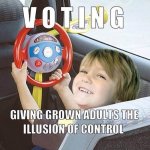

Voting discussion thread

Understanding that everything these days is political, what's the angle here for the Dems (Kagan, Jackson. Sotomayor)? Why do they want citizens to be able to sue the postal service? How is this going to help keep Dems in power?
I can only assume they weren't thinking that far ahead. On the flip side, it's puzzling to me that the conservative justices were this protective of an organization that we know beyond a shadow of a doubt is corrupt to the core.
 
Interesting. Here in AL our star is in the upper left corner. I assumed it would have been standardized across the country to make it easier for people to quickly find.


I have a passport for the first time in my life. Got it a few months ago when we also got one for my daughter. She is a senior in HS, and their senior trip is to Europe, so we figured one of us parents should have one just in case of an emergency.
The problem is not the star. Some states, including Alabama's, "real" driver's license won't scan at some airports, as happened to my friends in Kodiak, AK...
 
I can only assume they weren't thinking that far ahead. On the flip side, it's puzzling to me that the conservative justices were this protective of an organization that we know beyond a shadow of a doubt is corrupt to the core.
This is a puzzle to me. Corruption is abuse of public trust for private gain, or some definition close to that. The USPS is many things - inefficient, negligent, etc., but corrupt? Did you really mean in the classic sense?
 
  • Thank You
Reactions: 92tide
This is a puzzle to me. Corruption is abuse of public trust for private gain, or some definition close to that. The USPS is many things - inefficient, negligent, etc., but corrupt? Did you really mean in the classic sense?

Overview of USPS Corruption Cases​

Corruption within the United States Postal Service (USPS) has been highlighted through various scandals involving employees and contractors. These cases often involve bribery, fraud, and misconduct related to service contracts.

Notable Cases​

Josef Ratcliff Case​

  • Position: Former USPS purchasing and supply management specialist.
  • Charges: Conspiracy to commit fraud, extortion, and money laundering.
  • Details: Ratcliff allegedly provided confidential bid information to contractors in exchange for bribes, with contracts exceeding $10 million.

Zechariah Yi Case​

  • Position: Former Senior Network Operations Analyst.
  • Charges: Receiving a bribe by a public official.
  • Details: Yi accepted approximately $1.5 million in kickbacks from trucking companies for securing USPS contracts worth around $15 million.

Types of Corruption​

Contract Fraud​

  • Involves collusion between USPS employees and contractors to manipulate contract awards.
  • Common forms include bribery, kickbacks, and false claims.

Mail Theft and Embezzlement​

  • Employees have been found guilty of stealing mail and funds, including money orders.
  • Investigations often involve collaboration with law enforcement agencies.

Impact of Corruption​

Corruption within USPS not only affects financial integrity but also undermines public trust in the postal system. The agency has implemented measures to combat these issues, including investigations by the Office of Inspector General (OIG) and stricter oversight of contracts.
U.S. Department of Justice uspsoig.gov
 

Overview of USPS Corruption Cases​

Corruption within the United States Postal Service (USPS) has been highlighted through various scandals involving employees and contractors. These cases often involve bribery, fraud, and misconduct related to service contracts.

Notable Cases​

Josef Ratcliff Case​

  • Position: Former USPS purchasing and supply management specialist.
  • Charges: Conspiracy to commit fraud, extortion, and money laundering.
  • Details: Ratcliff allegedly provided confidential bid information to contractors in exchange for bribes, with contracts exceeding $10 million.

Zechariah Yi Case​

  • Position: Former Senior Network Operations Analyst.
  • Charges: Receiving a bribe by a public official.
  • Details: Yi accepted approximately $1.5 million in kickbacks from trucking companies for securing USPS contracts worth around $15 million.

Types of Corruption​

Contract Fraud​

  • Involves collusion between USPS employees and contractors to manipulate contract awards.
  • Common forms include bribery, kickbacks, and false claims.

Mail Theft and Embezzlement​

  • Employees have been found guilty of stealing mail and funds, including money orders.
  • Investigations often involve collaboration with law enforcement agencies.

Impact of Corruption​

Corruption within USPS not only affects financial integrity but also undermines public trust in the postal system. The agency has implemented measures to combat these issues, including investigations by the Office of Inspector General (OIG) and stricter oversight of contracts.
U.S. Department of Justice uspsoig.gov
Have you thought about the sheer size of the USPS? Certainly there are going to be bad apples and they are to be applauded for continuing to try and root out corruption where it's found. I still don't believe the USPS is corrupt as an organization...
 
  • Like
Reactions: Huckleberry

1) So this is the proposed Trump executive order on voting. I spotted two things right away. First, everyone has to register anew to vote. Second, using an absentee ballot will require a notary public to witness you signing it or it will be rejected.
1772241265305.png

2) Here you see that voters have to register ANEW (note that word, because that’s how they’ll reject voters) to vote in the 2026 midterms.
1772241281883.png
3) When you re-register to vote, if you want an absentee ballot, you have to meet certain conditions (like disability) and the request must have a signed affidavit.
1772241317301.png
4) Using an absentee ballot will require a notary public to stamp and sign it. Or it will be rejected. Notary public services cost money, usually around $50. This is the workaround Trump is using to ban absentee ballots.
1772241341872.png
5) There will be another federal secret police force for “election security” that reports directly to Trump alone. So this is something that, if it comes into existence, will turn the election into something that could result in mass arrests for “election fraud”.
1772241368328.png
6) If this is, in fact, something Trump is thinking about doing, he must be impeached and removed from office at once. This must be the number one priority of House Democrats to investigate and subpoena anyone involved with this. This order would end free elections in the US.
7) See here, the proposed executive order ties into what I revealed in the thread attached below.
1772241428912.png
1772241460202.png
1772241474173.png


Keep telling me how both parties are exactly the same. How there is no difference between Republicans and Democrats. Then tell me how this fits into your vision of what America stands for.

Is this Trump's plan? Time will tell, but many conservatives ridiculed the idea of Project 2025 being implemented and we see how that is turning out.
 

Cato Institute:

Draw the Line Now Against a Trump Election Takeover​


“Pro-Trump activists who say they are in coordination with the White House are circulating a 17-page draft executive order that claims China interfered in the 2020 election as a basis to declare a national emergency that would unlock extraordinary presidential power over voting,” reports the Washington Post. The executive order would decree various changes to election law that Trump has been conspicuously unable to convince Congress to enact. These could include a ban on no-excuse mail voting, “requiring voters to register anew for the 2026 midterms with proof of citizenship,” and giving various federal agencies answerable to the president “a role in identifying ineligible voters.”

It won’t work. Measures of this sort, assuming there is no other problem with them, have to be enacted by Congress using its Article I, Section 4, powers. Under our constitutional order, changes to election law cannot be imposed on states by executive whim, whether or not some supposed national-security rationale is proffered.

Per the Post’s reporting, the draft executive order is being pushed by some eccentric characters who have previously promoted conspiracy theories about the 2020 election that have been uniformly rejected by courts and disproved by impartial investigation. In most administrations, such conspiracry theories wouldn’t get an audience at all; however, Trump is an obvious exception, as one of the nation’s leading promoters of election falsehoods and as one who has hired bitter-end “Stop the Steal” officials to fill key jobs relating to election policy. He has also repeatedly floated the idea of attempting at least a partial election takeover without going through Congress.

To paraphrase a high official of this administration: We can do this the easy way or the hard way.

The easy way would be to drop this idea, backing off from it clearly and publicly. There will always be other ways to excite the base or make excuses for a poor showing in the midterms.

The hard way would be to proceed full speed ahead into a prospect of courtroom humiliation and public opposition compared with which the tariff and Immigration and Customs Enforcement rebuffs would be like a warm massage.

During Trump’s second term, he has already tried to usurp power over elections by executive order, and federal courts have repeatedly slapped him down.

Those 2025 challenges, filed in an off year, proceeded at a relatively leisurely pace. In election law, however, courts know how to move quickly when a prospective illegality threatens to deprive voters of immediately salient rights. We have reached that point right now, as voters have begun to cast their ballots in early primaries. Courts would likely expedite challenges to the massively disruptive changes here, and the slapdowns could come within weeks or even days.

In a piece last week for Election Law Blog, UCLA law professor Rick Hasen points out that the Supreme Court’s tariffs case provides some parallels with prospective litigation over Trump’s bids to usurp election powers. The Constitution could not be more explicit about reserving to Congress the power to “make or alter” regulations governing state conduct of federal elections. Ambiguous language in some emergency bill somewhere should in no way be read to signify that Congress somehow intended to delegate such power. And if a sudden takeover of elections does not trigger the major questions doctrine, what would?

Everyone who cares about federalism and the Constitution, especially lawmakers, should be drawing the line against this idea right now.
 
Advertisement

Trending content

Advertisement

Latest threads